Monthly Archives: March 2015

Singing in the Car

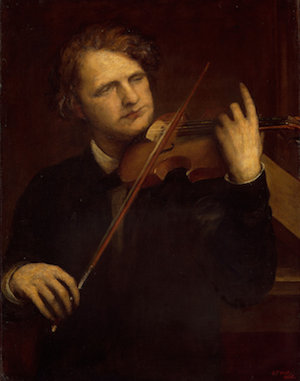
Painting of violinist Joseph Joachim by George Frederick Watts, 1868.
Famed 19th century violinist Joseph Joachim, who, among other things, premiered the Brahms violin concerto. I bet he didn’t practice in a horseless carriage! Painting by George Frederick Watts, 1868.

Once, in a conversation with the mother of a talented, but over-extended student — one who stacked up the extra-curricular activities like cordwood, as they say in Maine — I worried that my student didn’t have enough time to practice. The reply: “Oh, but she can practice in the car!”

Indeed, all that driving around: to chess club, riding lessons, violin lessons; to youth symphony rehearsals, piano lessons, Mandarin classes, and yes, voice lessons certainly gives a gal some quality time in the car. “But if she’s going to practice in the car,” I told her mother, “it should be violin.”

Needless to say, she looked at me like I was nuts. Come on! How are you supposed to practice violin while strapped in a car seat? How do you avoid continually jabbing the roof with your bow tip? Isn’t it a bad idea to have your instrument out in a moving vehicle, where any unconstrained item may turn into a projectile the moment things go south? And what about distraction? In 2013, roughly 512 people per day were involved in motor vehicle accidents in Minnesota. Just imagine how much worse it would be if we had a driving-while-fiddling epidemic!

Ah, but you say, “The voice is a hands-free instrument, perfectly suited to the car.”

In truth, I have nothing against singing in the car. I do it all the time. But I don’t practice there. For one thing, those bucket seats leave me feeling like I can barely breathe, as if my lungs were a bunch of rubber bands stuffed in a box. Second of all, the city where I live, like most cities around the world, is filled with people who spend way too much time in their cars. They hurtle around at high speeds; they’re late, they’re angry, and they’re right behind you. This may be a great time to belt out your favorite ditties, laced with expletives as people cut you off or tailgate, but is it really the time to transform your relationship with your voice?

But let’s forget the crazy drivers for a moment and go back to bucket seats and rubber bands.

Our bodies are filled with tissues with elastic qualities. What exactly does this mean?

Geza Peske painting of boys with a slingshot.
Imagining the potential of elasticity. An excerpt from Peske Geza’s work Zwei Buben mit Steinschleuder auf der Sommerwiese (Two Boys with Slingshot in the Summer Meadow), 1934.

When you stretch a rubber band, you are temporarily converting some of the movement energy you needed to stretch out the band into elastic potential. The band, when released, will return to its original shape, and in the process convert its elastic potential back into movement.

In our bodies, this interplay between movement driven by our muscles and movement driven by the elastic recoil of our connective tissues can make life a lot easier for us, if we’ll let it.

So where are these fabled rubber-band-like tissues of the body? Everywhere. Your ribs, for instance, will change their shape with a deep inhale, and then fuel part of the exhale with their elastic recoil. Feel it! Take a deep breath, and exhale on a hiss, without pushing. You’ll notice that you can exhale for quite a while before the abdominal muscles have to kick in. Thanks, elastic ribs!

Funny how we use elastic metaphors to describe the over-extended life. Someone who is stretched too thin might snap or even reach a breaking point. (Then perhaps she’ll rebound.) If you’re going to prime the great big rubber band that is your life, make sure you get to enjoy the recoil, the moment when you are flung across space in a way that seems effortless.

Meanwhile, practice in your body. You have an opportunity with every breath.

The Soft Palate: Imagining the Dome of the Sky

Illustration from a 13th century Latin bestiary.
A punctual bird. Illustration from a 13th century bestiary.

Once, I lived in a place where I could set my watch by the twice-daily glimpse of a heron commuting across the sky: west to east at 10:30 every morning; home again at four. I like a punctual bird.

And I like to look at the sky. It’s easy to lose sight of. Maybe you work in an office or a cubicle with no window. Or you are tethered, by work or by habit (or both) to a different sort of window, the one that glows on your desktop or on the the smart phone in the palm of your hand. (And here, in fact, you are.) But take a moment and find a patch of sky and have a gander. No matter who you are, the sky is there for you, and the same sky looks down on us all. Hello.

A couple of months ago, I decided to experiment with practicing in the dark. It was still winter, when the electric lights come on early and stay on late; when one feels a wee bit justified spending too much time at the computer because it’s so cold out; and when, in spite of the long nights, I realized I was essentially living my waking hours in a world without darkness, where, thanks to Thomas Edison’s incandescence (and its descendants), my visual sense could lord it over all the others, all the darn day (and night) long.

Music must be so different to us now in this world without darkness.

I decided to try practicing across the twilight hour, without turning on the lights. I wanted to feel my senses shift roles, and my eyes did not give up their dominance easily. Even as it became too dim to see my music, they turned to the view out the window, to glimpse what light remained in the sky through a latticework of tree branches.

When you don’t turn on the lights at dusk, the room you’re in becomes very small, and for a while, it feels much darker inside than out. The darkening sky, on the other hand, stays big, dome like, present.

A view of the 15th century sky, from Les Echecs amoureux.

I like to think of my soft palate as being part of this dome, that when I inhale, it dissolves into the sky.

Do you know where your soft palate is? It’s part of the roof of your mouth, in the back. If you put the tip of your tongue behind your upper front teeth and move it back across the roof of your mouth, you’ll first feel the bony hard palate, covered with mucous membrane. At the back of where you can reach with your tongue, you’ll feel the beginning of the soft palate, where there is no bone directly beneath the surface. This highly mobile area is important for shaping the sound that comes from our larynx into language, both vowels, as well as some consonants. For example, say [k] as in cat; [g] as in gold. For these consonants, the back of the tongue comes up against the soft palate. If you say [i] as in see or [u] as in true, you might be able to feel the back of the tongue approximate (draw close to) the soft palate.

The soft palate creates a kind of mobile roof to the oropharynx, an area of the vocal tract which plays a crucial role in resonance, by which the sounds from the larynx are acoustically amplified.

In addition to helping shape and amplify language, the soft palate can open and close the passage between the nose and the throat. This happens, for instance, when you swallow, which is why (thank goodness) you don’t get food or liquid up your nose every time you swallow (unless someone tells you something really funny at just the right moment, and you suddenly find yourself guffawing, while coffee drips out your nose). This door to the nose also has to open when we make any kind of humming sound, such as the nasal consonants [m], [n], and [ŋ] (as in singing).

But at the end of the day, as singers and as persons of voice, the most important thing we do with our voices is communicate with others, and sometimes this can be scary. Perhaps it is performance anxiety. Perhaps a difficult conversation, or even a confrontation. At times like this, I like to expand my image of my soft palate dissolving into the dome of the sky to include all the other soft palates in the room.

Give it a try sometime. No one ever needs to know you’ve just recruited their soft palate to be part of your sky dome.

Core Strength and the Singer

Eric Franklin, the Franklin Method’s progenitor, recently released a couple of short videos addressing the issue of core strength and breathing which I think are very useful for singers.

In this first video, he shows the relationship between the diaphragm and the abdominal wall muscles, and leads you through some breathing and movement exercises pertaining to the same.

In the second video, he shows the movement relationship between the diaphragm and the pelvic floor muscles, and again leads you through some basic movement and breathing exercises.

If you enjoyed these videos, I suggest heading over to the Franklin Method website and subscribing to their video library.

The Tongue: Prohibited Movements

Recently, someone showed me a handout she’d been given on vocal warm-ups. She pointed out a paragraph advising against exercises using the ng consonant — the hum created by placing the back of the tongue against the roof of the mouth. It’s the sound you make, for instance, in the word hangup. According to the handout, making this sound can cause a habit of tongue tension that is difficult to correct.

Prohibitions in the voice studio can be very useful. Here’s one I use all of the time:

Don’t you dare put your coffee cup on my piano.

Back to the ng.

If the ng is prohibited on the basis of its potential for causing tongue tension, then how is the singer supposed to sing this:

Thro’ all the tumult and the strife
I hear the music ringing;
It finds an echo in my soul—
How can I keep from singing?

I’m not sure how you’re supposed to get through all of that ringing and singing without the good old ng consonant, and hey, there’s a [k] – the back of the tongue comes up against the roof of the mouth to make this consonant, as well. Perhaps it should also be prohibited, just in case it causes a habit of tension. (According to phoneticists, the [k] is a near universal language sound, so perhaps excessive tongue tension is also nearly universal. It’s nice to think we’re all in this together.)

When we swallow, the tongue comes up against the roof of the mouth. (Try swallowing without letting the tongue touch the roof of your mouth, and let me know how it goes.) Maybe we should prohibit swallowing so we don’t develop patterns of excessive tongue tension.

Perhaps you get where I’m going here.

The tongue has to move when we use language, whether for singing or speaking. It moves a lot. It’s probably the most flexible group of muscles in the body (good for you, tongue!). At the same time, excessive tongue tension (which you can probably invoke by saying “excessive tongue tension” ten times fast) is a very real issue for speakers and singers alike. Every singer needs some skills to help find a balance between necessary tension and necessary relaxation in the tongue.

Here’s just one I’ve been using recently.

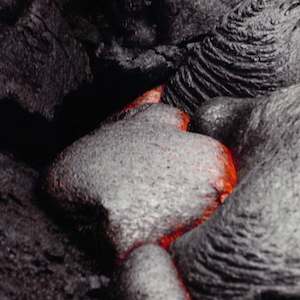
A lava tongue.
It might not work for you, but there are days when a nice, plump lava tongue does the trick.

Imagine your tongue is a river. You can think of it as having a unidirectional flow through its length, or you can think of a flow that eddies and swirls.

You might feel like you have some increased salivation with this exercise. Saliva is part of the alimentary system, and we salivate more when we’re relaxed and the parasympathetic part (rest and relaxation) of our autonomic nervous system can get down to business. (Conversely, lack of salivation, or dry mouth, is often a component of performance anxiety. Your fight or flight instinct kicks in, and your body figures it can take the production of saliva off line for a little while, while you channel your energies into getting away from the tiger that’s chasing you).

Because I live in Minnesota, where, as I write, it is still winter, I also like to use a little flow imagery I collected some years ago on a trip to the Big Island of Hawaii. There, in addition to being toasty warm, I was lucky to visit an active lava flow in Volcanoes National Park. Try thinking of your tongue as a slowly flowing and expanding tongue of lava.

Which reminds me of another of my studio prohibitions.

Don’t forget to breathe.

The Oropharynx: Imagery and Resonance

Let me tell you about the house in my imagination. You enter from any old closet. Make your way behind the hanging clothes. Find the small door. Get down on your hands and knees and crawl through; yes, it’s dark, but take courage! At the end, you find a door with an iron latch that leads to an attic under a peaked roof, with a window at the end letting in some light. There’s enough headroom in here for you to dust off your knees and stand up. In the middle of the floor is a staircase; follow it down a short flight, around a turn to the left, and you come into a large room with vaulted ceilings, filled with tables covered in old kitchen implements. The roof is a shambles, and vines drip down into the room from the missing sections; duck around them and take a gander at the stuff on the tables: Maybe you’ll find the perfect old teapot.

Once, a voice teacher, trying to help me develop my resonance, suggested that I imagine a huge house in the back of my head. “Right now, you’re just resonating in the kitchen,” she said. “Can you resonate in the whole house?”

She was asking me to call upon a mental image as a way of producing a change in my physical self-awareness, in my movement, and in my sound. Such mental imagery can be an incredibly powerful tool, and it’s one that all singers use. However, in order for it to be effective, it needs to be attached to real information about the body, and it has to be meaningful to you in a way that both makes your mind want to sit up and sniff the air, and is relevant to the movement change you want to make. My teacher’s suggested image of a “big house in the back” certainly caught my mind’s attention. Alas, she had no way of knowing that in my case this particular image would leave me crawling through secret passages and examining old spatulas. Metaphorical images like this one (there’s no actual house back there) are very personal. What works for one person may not work for another.

One of the challenges of working with the body is you can’t just look at things. You can’t, say, take apart your hip joint, as you would an old clock, in order to figure out what is twanging in there.

Luckily for us, other artists and scientists have been studying our insides for hundreds of years, cutting up the bodies of those who no longer need them, and in more recent years, developing non-invasive imaging technologies that can help us see inside the body in vivo. We can study this work to help us develop a clearer image of our own bodies, a repertory of anatomical imagery we can use to increase our sensory awareness, so we can learn to see with our minds the parts of our bodies we can’t see with our eyes.

So.

Let’s turn away from the table laden with old egg beaters and wooden spoons and see if we can develop an anatomical image of the oropharynx, the “big house in the back.”

Oropharynx

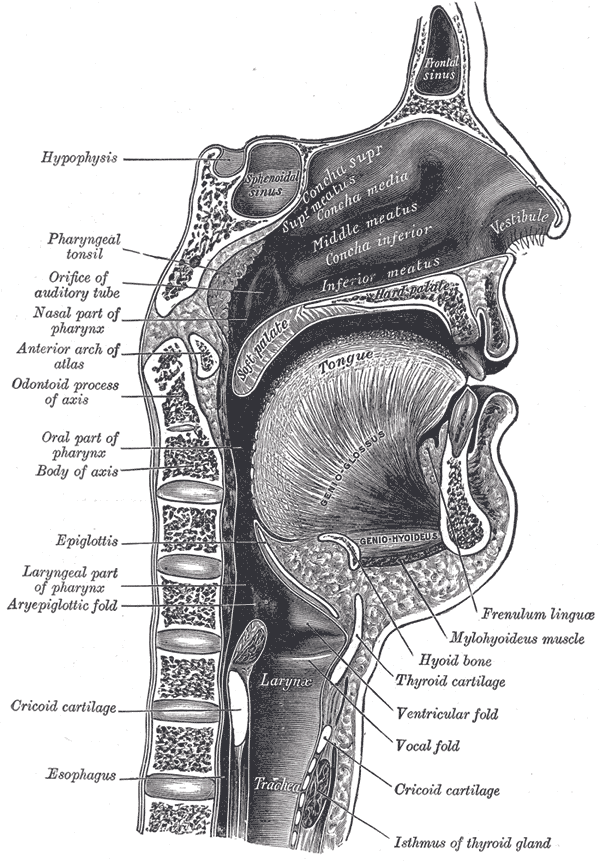
The oropharynx is an important area of resonance for the voice, in the throat, behind the tongue. In this drawing, it is labeled (on the left) “oral part of the pharynx.”

Some things to note: the tongue is a lot bigger than what you can see in the mouth. It forms the anterior (front) wall of the oropharynx, and its movement is part of how this entire area changes shape as we make different vowel sounds.

Vocal Tract
Vocal Tract from the 1918 Edition of Gray’s Anatomy.


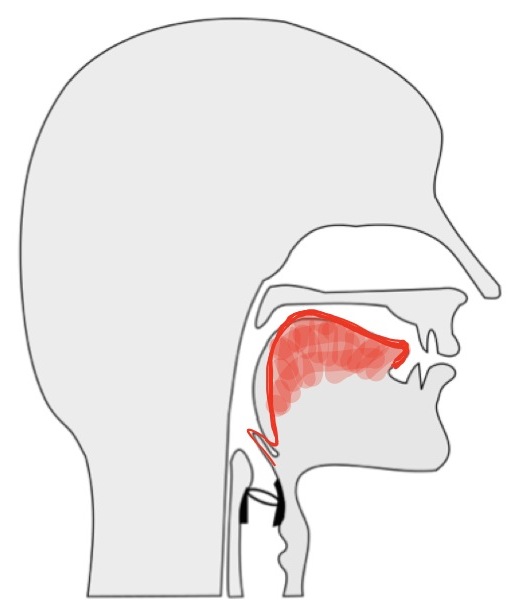
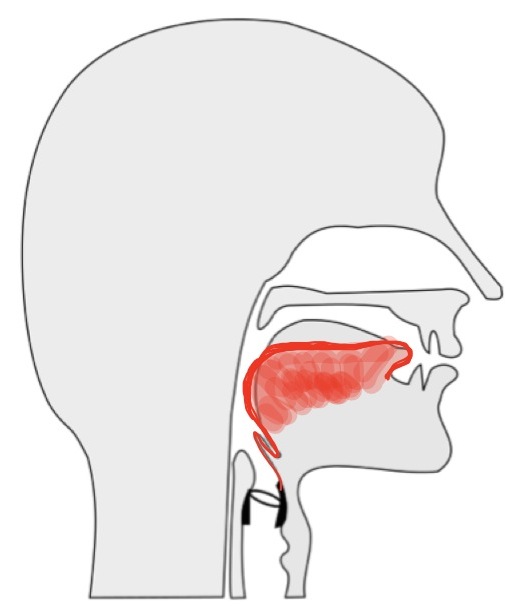
Here I’ve drawn in the tongue position for the [i] (as in tree) and [a] (as in father) vowels respectively. You can see that in the oropharynx, the [i] vowel has the larger space. When the tongue is in the [a] position, it’s moving back towards the spine.

tongue position for the "i" as in "tree" vowel.
Tongue position for the "a" as in "father" vowel.
Tongue positions for the [i] as in tree and [a] as in father vowels.


For an in vivo demonstration, I recommend the following video made by the the good folks at the Speech Production and Articulation Knowledge Group at the University of Southern California School of Engineering. It shows a real-time MRI of the vocal tracts of two different singers, one trained in a European classical tradition, and the other a beat boxer. The classical singer performs “O mio babbino caro.” Note how the space in the oropharynx changes between the [i] of mio and the [a] of caro. We often think of the [a] vowel as being the most open, and in the oral cavity, it is. In the oropharynx, on the other hand, it is the most narrow vowel.


After last week’s post on Singing and Wine, you have perhaps been sniffing at the world in a different way. Using the process of smelling can also be a good way of increasing your proprioceptive sense of the oropharynx.

Picture the vocal tract and oropharynx in your mind. Then inhale through the nose, feeling the air move against the mucosal lining of the nose and throat. Famed vocal pedagogue Richard Miller has a nice version of this exercise in The Structure of Singing (page 62):

With lips closed, breathe through the nose as though slowly inhaling a pleasant aroma; maintain a pleasant expression on the face without actually smiling.

(Just to be contrary, I tried this exercise while sporting a grimace. It still works, though the expression on your face probably won’t help your singing.)

Rather than thinking of the oropharynx as a large space, which can lead students to try and make it yet bigger, by hook or unnecessary crook, I like to focus on just experiencing its existence, and how much it moves when I sing and speak.

So get thee to the oropharynx and try on a little vowel dance!