Category Archives: Sass

Breathing, Holding, and Singing: A Primer on the Absurd

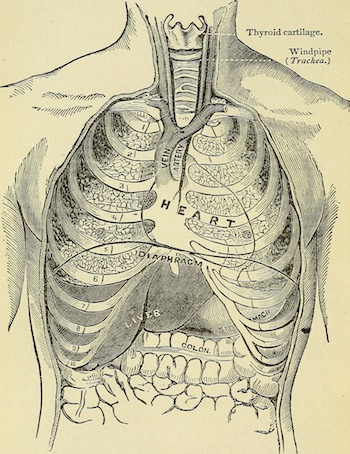
An illustration showing the diaphragm's position relative to the heart lungs (above) and abdominal muscles (below).
The diaphragm descends on the inhale, pulling on the lungs, which pull on the trachea, which pulls on the larynx. Illustration from Frederick Garbit’s (1880) The woman’s medical companion and guide to health.
When I teach breathing to singers, I tend to take a “try this and see what you feel” approach. I can’t clamber into anyone else’s body and feel what they’re feeling. In my view, it’s up to students to develop their own lexicon of sensations related to the breath. I can, at best, offer accurate information about different aspects of breathing: things to notice.

Like this: Start with an inhale. Your diaphragm descends, pulling your lungs and heart with it. Your lungs are connected to your trachea, which you can feel at the base of your neck, just above your sternum. Your trachea is connected to your larynx. On a deep inhale, you may be able to feel your larynx (Adam’s apple) move slightly downward. Notice. What happens when you start to speak or sing?

***

I like to collect odd instructions I’ve heard given to singers on the subject of breathing. Here’s one:

Lift your shoulders and hold them up so you can make more space for your lungs.

My lungs have always liked a little space, so while I’m at it, maybe I should get a bigger house? What the hell, maybe I should invade some other country so my lungs will have enough space!

Here’s another:

Squeeze your butt cheeks together and hold them so tight you couldn’t fit a tram ticket in there.

This one is clearly a partner exercise, with one person doing the cheek squeezing, and the other checking to make sure they can’t “fit the tram ticket in.” Don’t have a tram ticket? No worries. I’m sure your voice teacher can give you a business card to use instead.

And another:

Tense up your abdominal muscles as if someone is about to punch you and hold them there to support your singing.

Singing is, after all, very dangerous (especially if you’re invading other countries to make space for your lungs). You never know when someone might come along and punch you.

Okay, one more:

Inhale, let your ribs expand and hold them in this position for as long as possible on the exhale.

Hey, just as an experiment, why not try all four things at once? Lift your shoulders and give your lungs a little space. Tense up those buttocks, lest someone mistake you for a turnstile and try and “board your tram.” Inhale and expand your ribs. Tense up your abdominal muscles to support the exhale, and be sure keep your ribs out.

Ready to sing?

***

The above methods all have something in common: the injunction to hold.

When you hold, you are making something that should move static.

But breathing is dynamic. It involves movement of many bones, muscles, ligaments and organs. With all of these moving parts to organize, it’s no wonder the singer might sometimes take the rearranging-the-living-room-furniture approach to breathing: “Put this over here, that over there, and can you hold this picture up for me so I can see how it all looks?”

Let’s go back to noticing.

  1. Take a nice big inhale. Feel your rib cage expanding in all directions. (If you let your ribs move, you’ll probably find that your lungs have all the space they need!)
  2. Exhale on a sibilant [s] (hiss). The lungs are very elastic. If they weren’t anchored to the body wall, they’d crumple up into little balls. In a resting breath, we let this elasticity do most of the work of the exhale. See if you can sense this elastic recoil as you slowly exhale on the [s]. How long can you go without activating the abdominal muscles? (If you put your hands on your stomach, you should be able to feel when your abdominal muscles tense up.) Can you feel the movement of the exhale on all sides of your rib cage?
  3. On your next exhale, try singing one of the long-tone vocal function exercises, using just the elastic recoil of the lungs to provide the necessary air pressure. You won’t be able to sing the note as long, but it’s interesting to notice how much work the elastic recoil will do for you. (For me, this exercise has some of the qualities — such as ease and pleasure — of a sigh. An elongated sigh, mind you.)

    You cannot sing on the elastic recoil of the lungs alone. There has to be some balanced use of abdominal wall musculature. However, singers also need to learn to be able to feel the elastic recoil in the lung so they can tap into it, and let it do its share of the work.

Play with it. See what you notice.

Every breath is different.
The Chorister’s Lament: Why Your Feet Hurt So Much

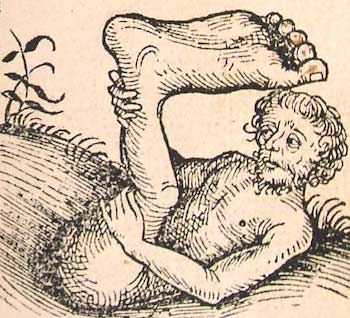
Monopod from the Nuremberg Chronicles.
The foot of the one-leggèd chorister hurts even more than those of us with two legs. This fellow is from a section of the 1493 Nuremberg Chronicles — written by Nuremberg doctor and humanist Hartman Schedel and illustrated by Michael Wolgemut and Wilhelm Pleydenwurff — describing odd peoples of the world.

I’m standing on my riser, shoulder to shoulder with my fellow choristers. During rehearsal, I thought we had a little more room; now it seems we have all become slightly swollen for the performance, and I cannot move in any direction without accidentally leaning on my neighbors. I am trying not to rest my music on the head of the person in front of me, and I can tell, by the regular rearrangement of my hair, that the person behind me is having a similar struggle. In spite of the fact that I’m wearing my ugliest and most comfortable black shoes, we’re only one song into the piece and already my feet hurt.

But when we expressed our concern during rehearsal about standing for so long, the director said: “Hey, I’m standing the whole time, too! Wear comfortable shoes.”

It is hard, at times like this, to keep my mind from wandering to thoughts of my new performance piece. It is written for 40 conductors and a single chorister. The chorister stands on a large, raised platform, where she has plenty of room to move around as the music demands. She has a stand so she doesn’t have to hold her music, and so she can give her full attention to the conductors. They stand on risers in front of her. Since there isn’t enough room to accommodate music stands, they are asked to hold their scores with one arm while conducting with the other. This obviously isn’t ideal, but fortunately there are enough of them to divvy up the task. One section conducts the beat. Another leads dynamic changes, and yet others are in charge of onsets and cut-offs. They can have a committee meeting later and decide who does what. In the meantime, conductors, please make sure you can see the chorister; you may have to shift a little to have clear sight lines. I realize it’s very crowded. Please do your best not to hit each other. This piece is 60 minutes long. Smile with your eyes!

If I were a better person, perhaps my hurting feet would not lead me so quickly into fantasies of vengeful performance art. Alas, I am deeply flawed. But here’s the thing: I spent years as a chorister trying to find shoes that were comfortable enough that my feet wouldn’t be in agony by the end of the concert. This was before I understood how the sensory receptors in the foot work.

We have sensory nerves (also called mechanoreceptors) throughout our bodies that send feedback to the brain about things like movement, pressure, and vibration. The feet have a lot of them.

One distinction that is made between these receptors is whether or not they are fast or slow adapting. Say, for instance, you get up in the morning and put on your shirt. The fast adapting sensory receptors in your arm will say: “Oh, hey, there’s a shirt!” They’ll send that signal to your brain for a short while, and then they’ll stop. Your brain really doesn’t need to be told all day that there’s a shirt rubbing against the skin of your arm. At the end of the day, when you take your shirt off, those same sensory receptors will fire again, and say: “Oh, hey, the shirt’s gone!”

Slow adapting sensory receptors, on the other hand, will continue to send a signal as long as the stimulus is present. This type of sensor is very important in the foot, because, among other things, it enables us to maintain our balance while standing and walking. If you’ve ever had the experience of trying to walk on a foot that’s “gone to sleep,” you know just how bad it can be when these sensory receptors go offline.

As choristers, when we are standing on risers, crowded enough that we can’t even shift our weight from one foot to another, the slow adapting sensory receptors in the foot will send a continuous signal to the brain, and before long, that message will be: “Ow. Ow. Ow. Ow. Hey, you’re still standing on me. Ow.” Comfortable shoes will help distribute the pain evenly over as much of the foot as possible, but they won’t do anything to change the essential nature of the mechanoreceptors in the foot.

The antidote? Movement.

In my fantasy piece, even though both the chorister and the conductors are standing for the same amount of time, the chorister’s feet don’t hurt. She has enough room to shift her weight from one foot to another without bumping into someone or having to worry about blocking the view for the people behind her. The conductors, on the other hand, crowded on their risers with no room to move, are starting to have trouble focusing on their music as their feet clamor for relief. They may start making silly mistakes, missing cues, or getting off of the beat.

So what’s a conscientious choir director to do?

  • A little extra space goes a long ways. When we shift our weight from one foot to the other, our whole body shifts so our weight is over the standing leg. Depending on the size and stance of the person, the head can easily shift between 4 and 8 inches to one side. That extra room means you won’t bump into your neighbor or block the view of the person behind you.

  • Got a big choir and not quite enough space? Gospel choirs have figured this one out! Everyone shifts from one foot to the other together. Sing some gospel tunes!

  • Got a big choir and not enough space and you’re not singing gospel music? I just invented a new notation for you! We notate breath marks and consonant placement for cut-offs in our music. Why not coordinated shifts from one foot to the other?

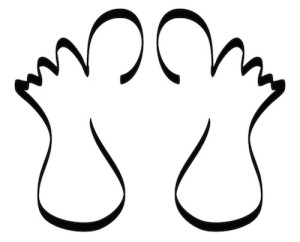
    New symbols to be added to the music notation lexicon, indicating weight distribution through left and right foot, respectively.
    New symbols to be added to the music notation lexicon, indicating weight distribution through left and right foot, respectively.

The Tongue: Prohibited Movements

Recently, someone showed me a handout she’d been given on vocal warm-ups. She pointed out a paragraph advising against exercises using the ng consonant — the hum created by placing the back of the tongue against the roof of the mouth. It’s the sound you make, for instance, in the word hangup. According to the handout, making this sound can cause a habit of tongue tension that is difficult to correct.

Prohibitions in the voice studio can be very useful. Here’s one I use all of the time:

Don’t you dare put your coffee cup on my piano.

Back to the ng.

If the ng is prohibited on the basis of its potential for causing tongue tension, then how is the singer supposed to sing this:

Thro’ all the tumult and the strife
I hear the music ringing;
It finds an echo in my soul—
How can I keep from singing?

I’m not sure how you’re supposed to get through all of that ringing and singing without the good old ng consonant, and hey, there’s a [k] – the back of the tongue comes up against the roof of the mouth to make this consonant, as well. Perhaps it should also be prohibited, just in case it causes a habit of tension. (According to phoneticists, the [k] is a near universal language sound, so perhaps excessive tongue tension is also nearly universal. It’s nice to think we’re all in this together.)

When we swallow, the tongue comes up against the roof of the mouth. (Try swallowing without letting the tongue touch the roof of your mouth, and let me know how it goes.) Maybe we should prohibit swallowing so we don’t develop patterns of excessive tongue tension.

Perhaps you get where I’m going here.

The tongue has to move when we use language, whether for singing or speaking. It moves a lot. It’s probably the most flexible group of muscles in the body (good for you, tongue!). At the same time, excessive tongue tension (which you can probably invoke by saying “excessive tongue tension” ten times fast) is a very real issue for speakers and singers alike. Every singer needs some skills to help find a balance between necessary tension and necessary relaxation in the tongue.

Here’s just one I’ve been using recently.

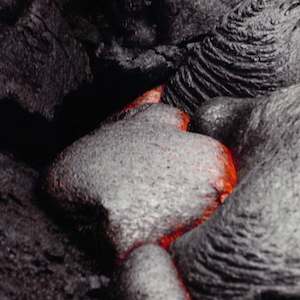
A lava tongue.
It might not work for you, but there are days when a nice, plump lava tongue does the trick.

Imagine your tongue is a river. You can think of it as having a unidirectional flow through its length, or you can think of a flow that eddies and swirls.

You might feel like you have some increased salivation with this exercise. Saliva is part of the alimentary system, and we salivate more when we’re relaxed and the parasympathetic part (rest and relaxation) of our autonomic nervous system can get down to business. (Conversely, lack of salivation, or dry mouth, is often a component of performance anxiety. Your fight or flight instinct kicks in, and your body figures it can take the production of saliva off line for a little while, while you channel your energies into getting away from the tiger that’s chasing you).

Because I live in Minnesota, where, as I write, it is still winter, I also like to use a little flow imagery I collected some years ago on a trip to the Big Island of Hawaii. There, in addition to being toasty warm, I was lucky to visit an active lava flow in Volcanoes National Park. Try thinking of your tongue as a slowly flowing and expanding tongue of lava.

Which reminds me of another of my studio prohibitions.

Don’t forget to breathe.

Singing and Wine

I confess, I like a glass of wine with dinner, and I’m a bottom shelf red kind of gal. It’s better for your budget and it gives you a chance to get some exercise as you peruse the aisles, practicing your squats in order to read the little cards with wine descriptions on them, like this one:

Spicy, “brushy” flavors of black cherry and dried berries accompanying notes of roasting coffee and campfire smells. Description courtesy by the good folks at Lake Wine and Sprits in Minneapolis.
Spicy, “brushy” flavors of black cherry and dried berries accompanying notes of roasting coffee and campfire smells. Description courtesy of the good folks at Lake Wine and Sprits in Minneapolis.

The description is certainly evocative. Already, I can imagine the brush pile I’ve gathered to add to the fire beneath my skillet. In my mind, I see the texture of the sticks, and I can imagine their smell (along with a general sense of being damp and cold, alas). But I still have no idea of how this wine will taste. After all, I haven’t invested any time in developing my palate and taste memory, or a consistent language for talking about these things. I am reduced to relying on descriptions given to me by the wine merchant, and the vague recollection of having enjoyed wines in the past whose descriptions invoked the fabled black cherry (a fruit I’ve never tasted).

Talking about singing shares some of the same challenges as talking about wine. Your experience as a singer, just like your experience tasting things, is completely subjective. No one else gets to hear or feel what you’re hearing and feeling as you sing. We can certainly take guidance from other singers and from our teachers. But ultimately, we must develop our own memory bank of sense experiences, our own language to describe them.

The downside is that there’s a lot to learn. The upside is that the mind loves novelty. When you learn something new in the body, even in an area that seems outside the realm of vocal technique, your sound will benefit. For the singer, the entire body is the palate for the voice.

For inspiration, I offer up the advice of Victor Hazan, from the chapter on tasting in his 1982 book Italian Wine (page 10):

Using one’s nose is the most elusive exercise in tasting. To harness this impetuous organ we need to learn how to add mindfulness to instinct. One difficulty is that the words that describe scents usually reach us with more force than the scents themselves. Such words as rose, violet, pepper, coffee rush to our brain, arousing imperious sensations that do not seem quite to match the ethereal fragrances in wine that go by the same name.

Another problem is our impoverished store of remembered smells. The fragrances of honestly ripened fruit, of wild berries and mushrooms, of field flowers, of wood have been edited out of everyday experience and replaced by those of plastic film, metal foil, polymers, and acetate.

For many of us it will be necessary to replenish the depleted stores of our olfactory memory, conducting our noses through produce markets, gardens, fields, woods, wherever it can assemble the most varied collection of well-identified impressions. Most of what a wine has to tell is spoken by its odors. Smelling is the most intimate contact we have with wine, when we draw close to, as it were, its very breath.

Go forth and smell the world, oh singer, lest ye be reduced to buying the voice based only on the label.

Get your magical singing panties here!

In the course of my singing life, I am often approached by non-singers with wistful looks who confess some version of: “I’ve always wanted to be able to sing, but I can’t carry a tune in a bucket.” (Why anyone would attempt to carry a tune in a bucket is beyond me, since we all know that there’s a hole in that bucket.) Over the years these conversations have taken place at my church and synagogue jobs, at family gatherings, and in recent years, as I’ve studied anatomy and movement, in conversations with Pilates and yoga instructors, dancers and physical therapists. My stock answer is this: “Do you have your pair of magical singer’s panties, yet?”

It is well known within the super-secret society of singers that the key to good singing is Singer’s Underpants, and anyone who’s serious about singing has a pair. So if your kids burst into tears whenever you sing; if you were traumatized by a junior high school choir director who begged you to “just mouth the words”; if your neighbors fire up their lawn mowers every time you belt out a ditty and the cat runs away, you just need a pair of singer’s underpants.

Alas, I jest. If only there were such a thing.

Still, the good news is that you can learn to sing, or get better at the singing you’re already doing, and you can do so while wearing whatever underpants you already possess.

At its best, singing is something we do with the whole body, and when you get your whole body working for your voice, it feels amazing, like you’ve developed a super power. “Oh come on,” you say. “I don’t sing with my feet!” To which I offer this challenge: “Stand up and sing your national anthem (or your personal anthem, should you prefer to think of yourself as a citizen of the world). One, two, ready, sing!”

Oh, wait! Are you standing on your feet and singing?

Okay, so you use your body to sing. So let’s learn more about it and how it moves. Let’s get the whole body working for the voice, from scalp to toes. Whether you’re a professional singer, or a wistful yearner still carrying your tunes in a proverbial bucket, this series is for you.