Category Archives: Resonance

Thinking Beyond the Soft Palate: Vibrating the Sella Turcica

The voice needs a core. I’ve always thought of this core as a pointy little sound that happens somewhere in the middle of my head. One can, of course (and should), build something bigger around this core, but first the voice needs a steady hearth to live by. As famed vocal pedagogue Giovanni Lamperti put it:

Not until the focus of voice is like a fixed star in your head, kept in position by the powers inside and outside your body, can you sing1.

Finding this core to the sound is part of the process of developing resonance, and like many aspects of vocal technique, involves improving your ability to perceive — to feel — what is going on in your body.

One of the relevant areas is the soft palate, the part of the roof of your mouth behind the bony hard palate. This area moves a lot during phonation, and there is generally much talk about what you should be doing with it while singing. I have no intention of addressing the issue here. Instead, I want to talk about using the sensation of vibration in the bone above the soft palate as a meditation for resonance.

Some weeks ago, I talked about the idea of movement between the different bones of the skull, specifically looking at the maxilla, which holds the upper teeth, and forms most of the hard palate. Today’s bone-for-reflection, which hovers above the soft palate and the nasopharynx, is arguably the most beautifully-shaped bone in the body: the sphenoid.
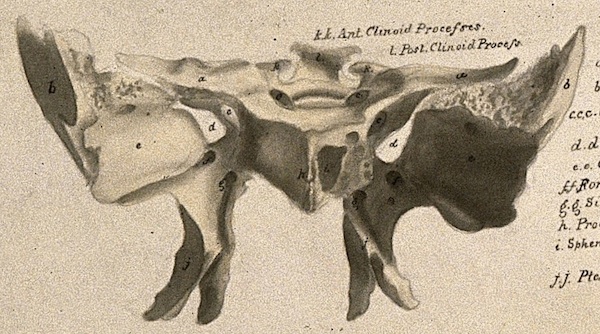
Anterior view of the sphenoid
Is it a bird? Is it a moth? No! It’s an anterior view of the sphenoid! Illustration from an unknown work on anatomy, circa 1830. Image credit: Wellcome Library, London.

Most of the surfaces of the sphenoid are inaccessible to touch. We can feel its greater wings at the temples, just behind the outer edges of the eye sockets:
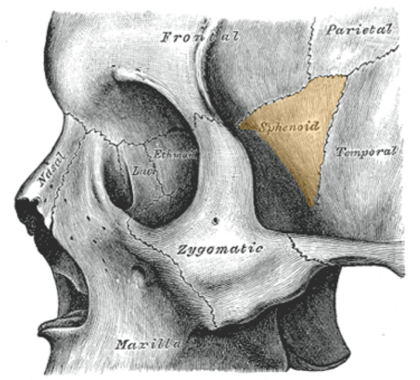
View of the side of the skull showing the location of the sphenoid bone at the temple.

(We can also touch its insect-leg-like hamular process inside the mouth, but you’ll have to ask your friendly craniosacral therapist for help with that one.)

The part of the sphenoid I want to focus on for the moment is a structure which lies directly above the soft palate called the sella turcica, and yes, that means “Turkish saddle.” It’s a cradle of bone on the inside floor of the skull which rocks the pituitary gland.

A Turkish saddle, high in the front and back, just like our friendly pituitary cradle. Illustration by Sir Henry Austen Layard: Nineveh and Babylon, 1882.

And because you should never look at just one anatomical illustration if you can look at five, I offer three public-domain images showing the location of the sella turcica in a sagittal view of the head (get thee to the interwebs if you want to find more).

This first image is from the ubiquitous Gray’s Anatomy. The sella turcica is circled, and labeled “Hypophisis” by the illustrator. Hypophisis is another word for the pituitary gland, which rests in the bony cradle.
Sella Turcica from Gray's Anatomy


In this second illustration by Patrick Lynch (made in collaboration with Carl Jaffe, MD, cardiologist), we can see the pituitary hanging down into the sella turcica. Note the structure’s position relative to the soft palate and oropharynx.
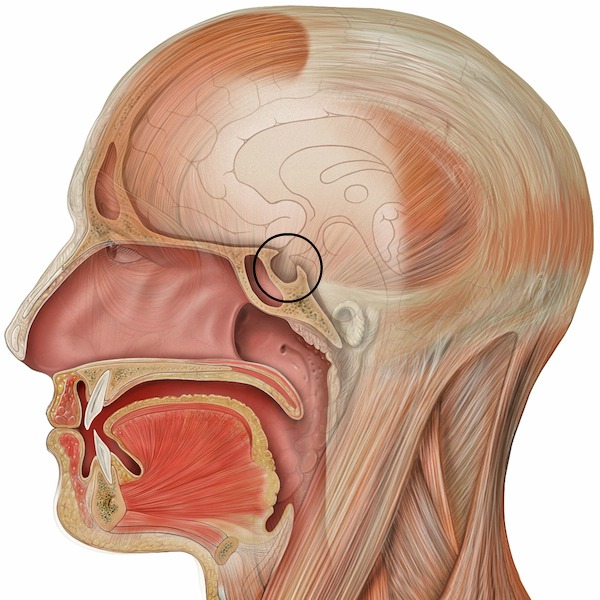
Sella Turcica by Patrick Lynch


This third image is from a 1910 German Anatomy Textbook, Der ärztliche Ratgeber in Bild und Wort. Atlas und Hausbuch für Gesunde und Kranke. Here, you can also see the pituitary, looking like a couple of little eggs nestled into the Turkish saddle.
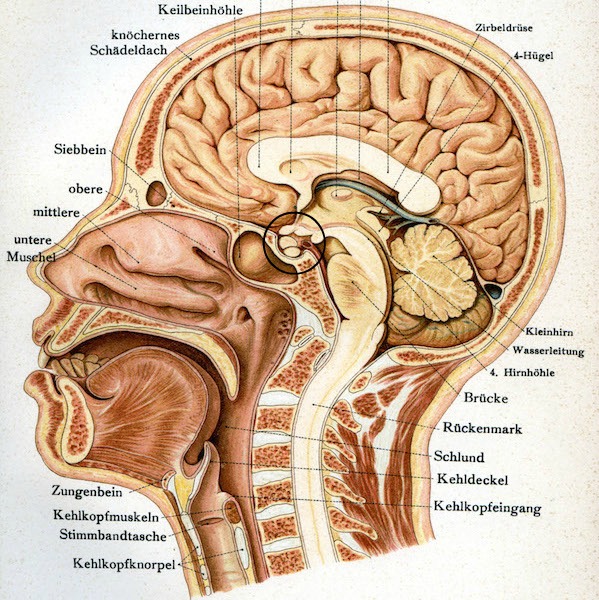
Sella Turcica from German Anatomy Textbook


I like to think of vibrating the sella turcica, because for me the sensation of vibration in the area brings more awareness to the soft palate.

  1. To help imagine its location, place your finger at the top of your nose, at the bottom of the forehead. This is roughly the level of the sella turcica. Imagine a line going straight back from here.
  2. Find the outside edges of your eye sockets. Move your fingers back from here about an inch. Your fingers will now be on your temples, perhaps in the vicinity of your hairline (unless, like me, you’re bald). Imagine a line going through your skull, between your fingers. This line intersects the sella turcica
  3. Move your fingers back and forth between these two imaginary lines. Can you visualize where they intersect? As you do this, hum or sing a soft note, making sure you try different pitches and registers. Can you feel vibration in this area?

Give it try! Perhaps while you’re practicing your Vocal Function Exercises!
What Once Was Solid

Ah, January!

Skull detail by Leonardo da Vinci
Leonardo grabs his skull and hoofs it on over to winter.
If you’re north enough, you’ve taken to shoveling your water into piles, and if you live in an old and drafty place like I do, Jack Frost comes in the night and decorates your windows with one-of-a-kind works of art. January in the north is when everything gets cold and hardens. What better time to think about things we perceive as solid? So grab hold of that hard head of yours, and let’s take a moment to talk about the skull.

Seattle poet Greta Nintzel sometimes calls the skull a “calcium cage.” Until recently, I admired the phrase as an apt description for my own noggin’: a bony container for the wizard running my body machine.

Enter the craniosacral therapist. She put her hands on my head and made the subtlest of movements. I started to think: maybe I’m not as hard-headed as I thought.

Craniosacral therapy is based (in part) on the idea that the bones of the skull retain some amount of movement at the sutures where they grow together during development2. I have a picture in my mind of the half-baked, developing skull as a group of islands, slowly expanding towards one another until they can start to merge together, first as continents, and then as a whole, head-shaped planet.

Before the craniosacral therapist put her hands on my skull, I had no thought of there being movement in the skull itself, my oh-so-solid calcium cage. And now? I think of the bones as having slightly lubricated edges, as if they are moored to one another on the sea of my gray matter, bobbing and floating (while I dreamily listen to the halyards slapping against the mast).

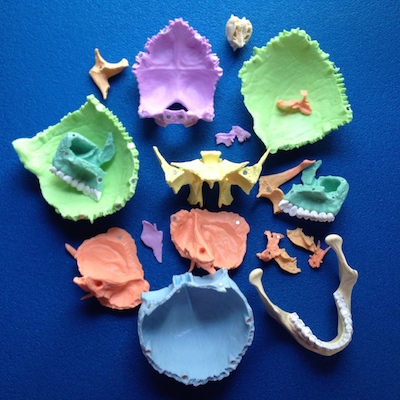
There is some disagreement on what should or shouldn’t be counted in this bony island archipelago, but for our purposes, let’s say there are 22 bones of the skull, as in this disarticulated model (Legos for anatomy geeks):

Disarticulated Skull

 
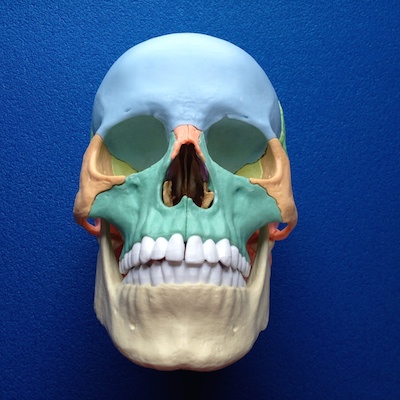
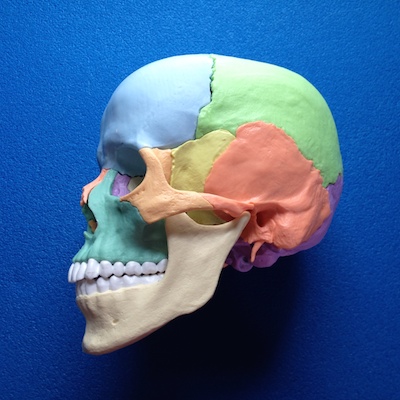
And here it is again, put back together:

skull model anterior view
skull model sagittal view


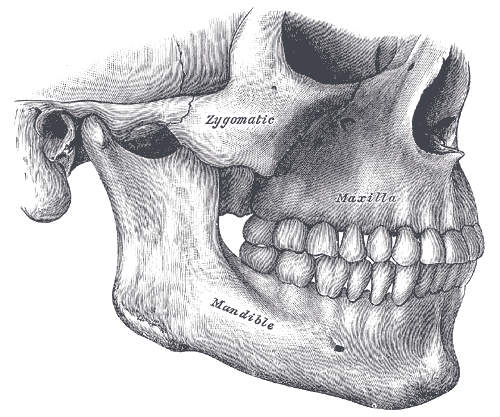
Among all these, I want to draw your attention to the maxillary bones, which are just below the nasal opening (teal in the images above). They hold your upper teeth and provide most of the surface of your hard palate. Here is another image from the 1918 edition of Gray’s Anatomy:

Maxilla from Gray's Anatomy


Previously, I introduced you to Joseph Stemple’s Vocal Function Exercises, and promised some things to contemplate while practicing them. So let’s vibrate the maxilla.

  1. As you hum, see if you can sense vibration in this bone (try different pitches). It’s easy to palpate its location, through the skin and muscles of your face, and also inside your mouth. If you feel the midline of your hard palate with your tongue, you can probably find the seam where the two halves of the maxilla join together. Can you feel the hum vibrating in different areas of the bone and in your upper teeth?
  2. The roof of your mouth is also the floor of your nose. Inhale slowly through your nose. Can you use the sensation of air coming in to help you sense the top (superior aspect) of the maxilla? What happens if you think of the hard palate widening slightly with the inhale?
  3. In the Vocal Function Exercises, we learned to sing long-tones on what I call the [o] inside an [u] vowel. Here, once again, is an example of the vowel:


    Because the embouchure of the closed [u] vowel is so tight, it can be tiring to hold the position for the duration of the exercise. To counter this, I like to imagine I can relax my upper teeth, as if I’m “letting them go”, and let them buzz in their sockets a little.

And hey, once you’ve vibrated the maxilla, we’ve only 20 bones to go in our vibratory exploration of the bones of the skull (the maxilla counts as two bones, with left and right halves).

Have fun!

Warming up the Voice with Vocal Function Exercises

Want to sing happily into your wise years? All the more reason to practice your vocal function exercises! Old Woman Singing by Dutch painter Gerard van Honthorst (1590-1656).
Imagine a different sort of violin. Rather than four strings, it has just one, and you don’t have to finger it to change the note. Instead, you must think the note; the string will automatically change its length and thickness to suit. The body of the violin is also continuously changing its shape as you play. Granted, this is awkward, but at least you only have one string to worry about!

Of course, what I’m trying to do here is imbue the violin with some of the qualities of the voice. The string of my one-stringèd violin represents the vocal folds, which vibrate to produce a tone. The body of the violin is the vocal tract, which adds resonance and amplification to the vibration so it can be heard on the other side of the hall. As for the other aspects of the voice, the breath, the articulators (mouth, tongue, lips, teeth — without which we’d have no consonants), I think I’ll hang up my hat on those rather than try and extend the analogy.

In short, the voice is a complicated instrument with a tremendous amount of variability in all of its parts. So how do you train the coordination between these parts?

Perhaps you do something to relax your body; to release tension in your neck, shoulders, and jaw, for example. Maybe you do something to warm up your breath. You might have a process to prepare yourself mentally, to clear the emotional detritus of your day. Perhaps — before you get down to the business of smoothing over your vocal galumphs with messe di voce exercises, with glides and vowel dances, with long tones and passage work — you engage in a ritual procrastination during which you clean the house, walk the dog, or “practice” yoga by lying in child’s pose and moaning3.

Enter my latest favorite warm-up: the Vocal Function Exercises developed by speech pathologist Joseph Stemple4 and colleagues5. As I understand it, their primary goal is to strengthen the muscles involved in phonation at the level of the larynx. Most recently, I’ve been using them to rehabilitate my voice after a month with bronchitis (which led to fantasies about next year’s Christmas CD: Meditations on Not Coughing). I’ve also found them very effective at improving the coordination between the breath, the vibration of the vocal folds, and the “placement” of the tone.

I will be honest: these exercises can be a little bit boring. But oh, the results! Give them a try.

Vocal Function Exercises

In the coming weeks, I will offer up some movement meditations I’ve used to keep myself engaged with these exercises. Because: the more mindful you can be in your practice, the more effective and transformative that practice will be. And variety is the spice of mindfulness!

The Soft Palate: Imagining the Dome of the Sky

Illustration from a 13th century Latin bestiary.
A punctual bird. Illustration from a 13th century bestiary.

Once, I lived in a place where I could set my watch by the twice-daily glimpse of a heron commuting across the sky: west to east at 10:30 every morning; home again at four. I like a punctual bird.

And I like to look at the sky. It’s easy to lose sight of. Maybe you work in an office or a cubicle with no window. Or you are tethered, by work or by habit (or both) to a different sort of window, the one that glows on your desktop or on the the smart phone in the palm of your hand. (And here, in fact, you are.) But take a moment and find a patch of sky and have a gander. No matter who you are, the sky is there for you, and the same sky looks down on us all. Hello.

A couple of months ago, I decided to experiment with practicing in the dark. It was still winter, when the electric lights come on early and stay on late; when one feels a wee bit justified spending too much time at the computer because it’s so cold out; and when, in spite of the long nights, I realized I was essentially living my waking hours in a world without darkness, where, thanks to Thomas Edison’s incandescence (and its descendants), my visual sense could lord it over all the others, all the darn day (and night) long.

Music must be so different to us now in this world without darkness.

I decided to try practicing across the twilight hour, without turning on the lights. I wanted to feel my senses shift roles, and my eyes did not give up their dominance easily. Even as it became too dim to see my music, they turned to the view out the window, to glimpse what light remained in the sky through a latticework of tree branches.

When you don’t turn on the lights at dusk, the room you’re in becomes very small, and for a while, it feels much darker inside than out. The darkening sky, on the other hand, stays big, dome like, present.

A view of the 15th century sky, from Les Echecs amoureux.

I like to think of my soft palate as being part of this dome, that when I inhale, it dissolves into the sky.

Do you know where your soft palate is? It’s part of the roof of your mouth, in the back. If you put the tip of your tongue behind your upper front teeth and move it back across the roof of your mouth, you’ll first feel the bony hard palate, covered with mucous membrane. At the back of where you can reach with your tongue, you’ll feel the beginning of the soft palate, where there is no bone directly beneath the surface. This highly mobile area is important for shaping the sound that comes from our larynx into language, both vowels, as well as some consonants. For example, say [k] as in cat; [g] as in gold. For these consonants, the back of the tongue comes up against the soft palate. If you say [i] as in see or [u] as in true, you might be able to feel the back of the tongue approximate (draw close to) the soft palate.

The soft palate creates a kind of mobile roof to the oropharynx, an area of the vocal tract which plays a crucial role in resonance, by which the sounds from the larynx are acoustically amplified.

In addition to helping shape and amplify language, the soft palate can open and close the passage between the nose and the throat. This happens, for instance, when you swallow, which is why (thank goodness) you don’t get food or liquid up your nose every time you swallow (unless someone tells you something really funny at just the right moment, and you suddenly find yourself guffawing, while coffee drips out your nose). This door to the nose also has to open when we make any kind of humming sound, such as the nasal consonants [m], [n], and [ŋ] (as in singing).

But at the end of the day, as singers and as persons of voice, the most important thing we do with our voices is communicate with others, and sometimes this can be scary. Perhaps it is performance anxiety. Perhaps a difficult conversation, or even a confrontation. At times like this, I like to expand my image of my soft palate dissolving into the dome of the sky to include all the other soft palates in the room.

Give it a try sometime. No one ever needs to know you’ve just recruited their soft palate to be part of your sky dome.

The Oropharynx: Imagery and Resonance

Let me tell you about the house in my imagination. You enter from any old closet. Make your way behind the hanging clothes. Find the small door. Get down on your hands and knees and crawl through; yes, it’s dark, but take courage! At the end, you find a door with an iron latch that leads to an attic under a peaked roof, with a window at the end letting in some light. There’s enough headroom in here for you to dust off your knees and stand up. In the middle of the floor is a staircase; follow it down a short flight, around a turn to the left, and you come into a large room with vaulted ceilings, filled with tables covered in old kitchen implements. The roof is a shambles, and vines drip down into the room from the missing sections; duck around them and take a gander at the stuff on the tables: Maybe you’ll find the perfect old teapot.

Once, a voice teacher, trying to help me develop my resonance, suggested that I imagine a huge house in the back of my head. “Right now, you’re just resonating in the kitchen,” she said. “Can you resonate in the whole house?”

She was asking me to call upon a mental image as a way of producing a change in my physical self-awareness, in my movement, and in my sound. Such mental imagery can be an incredibly powerful tool, and it’s one that all singers use. However, in order for it to be effective, it needs to be attached to real information about the body, and it has to be meaningful to you in a way that both makes your mind want to sit up and sniff the air, and is relevant to the movement change you want to make. My teacher’s suggested image of a “big house in the back” certainly caught my mind’s attention. Alas, she had no way of knowing that in my case this particular image would leave me crawling through secret passages and examining old spatulas. Metaphorical images like this one (there’s no actual house back there) are very personal. What works for one person may not work for another.

One of the challenges of working with the body is you can’t just look at things. You can’t, say, take apart your hip joint, as you would an old clock, in order to figure out what is twanging in there.

Luckily for us, other artists and scientists have been studying our insides for hundreds of years, cutting up the bodies of those who no longer need them, and in more recent years, developing non-invasive imaging technologies that can help us see inside the body in vivo. We can study this work to help us develop a clearer image of our own bodies, a repertory of anatomical imagery we can use to increase our sensory awareness, so we can learn to see with our minds the parts of our bodies we can’t see with our eyes.

So.

Let’s turn away from the table laden with old egg beaters and wooden spoons and see if we can develop an anatomical image of the oropharynx, the “big house in the back.”

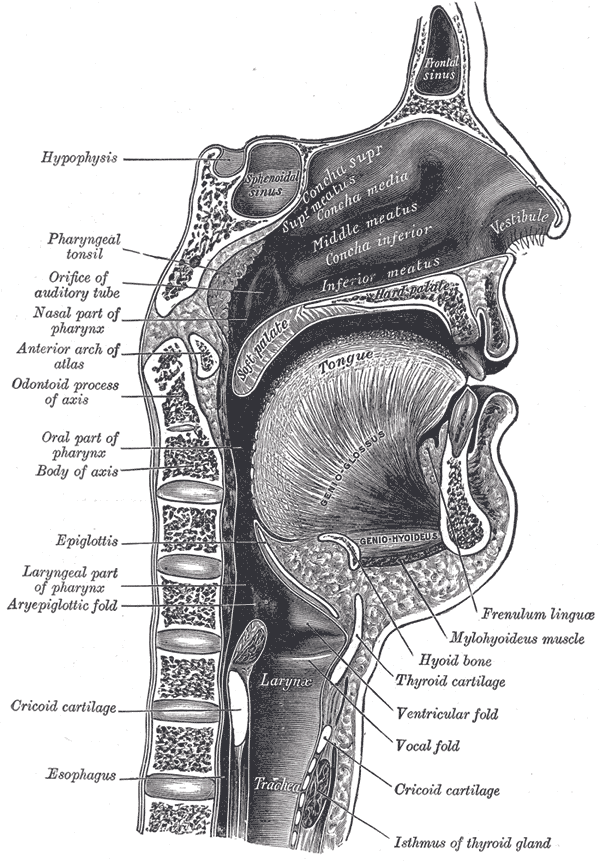
Oropharynx

The oropharynx is an important area of resonance for the voice, in the throat, behind the tongue. In this drawing, it is labeled (on the left) “oral part of the pharynx.”

Some things to note: the tongue is a lot bigger than what you can see in the mouth. It forms the anterior (front) wall of the oropharynx, and its movement is part of how this entire area changes shape as we make different vowel sounds.

Vocal Tract
Vocal Tract from the 1918 Edition of Gray’s Anatomy.


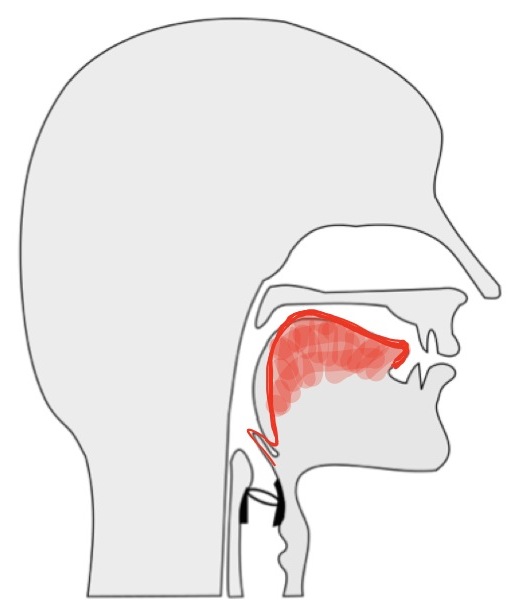
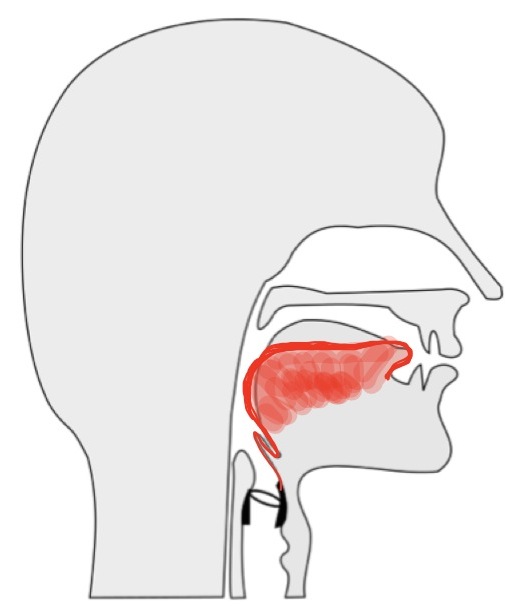
Here I’ve drawn in the tongue position for the [i] (as in tree) and [a] (as in father) vowels respectively. You can see that in the oropharynx, the [i] vowel has the larger space. When the tongue is in the [a] position, it’s moving back towards the spine.

tongue position for the "i" as in "tree" vowel.
Tongue position for the "a" as in "father" vowel.
Tongue positions for the [i] as in tree and [a] as in father vowels.


For an in vivo demonstration, I recommend the following video made by the the good folks at the Speech Production and Articulation Knowledge Group at the University of Southern California School of Engineering. It shows a real-time MRI of the vocal tracts of two different singers, one trained in a European classical tradition, and the other a beat boxer. The classical singer performs “O mio babbino caro.” Note how the space in the oropharynx changes between the [i] of mio and the [a] of caro. We often think of the [a] vowel as being the most open, and in the oral cavity, it is. In the oropharynx, on the other hand, it is the most narrow vowel.


After last week’s post on Singing and Wine, you have perhaps been sniffing at the world in a different way. Using the process of smelling can also be a good way of increasing your proprioceptive sense of the oropharynx.

Picture the vocal tract and oropharynx in your mind. Then inhale through the nose, feeling the air move against the mucosal lining of the nose and throat. Famed vocal pedagogue Richard Miller has a nice version of this exercise in The Structure of Singing (page 62):

With lips closed, breathe through the nose as though slowly inhaling a pleasant aroma; maintain a pleasant expression on the face without actually smiling.

(Just to be contrary, I tried this exercise while sporting a grimace. It still works, though the expression on your face probably won’t help your singing.)

Rather than thinking of the oropharynx as a large space, which can lead students to try and make it yet bigger, by hook or unnecessary crook, I like to focus on just experiencing its existence, and how much it moves when I sing and speak.

So get thee to the oropharynx and try on a little vowel dance!