Category Archives: Body

Anatomy and Interpretation: What the Singer should Know

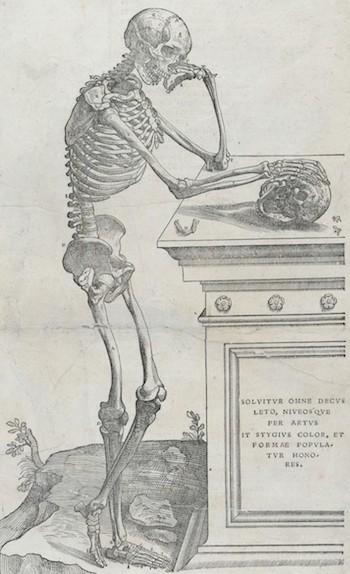
Skeleton from Andreas Vesalius' De humani corporis fabrica, published in 1543. The words on the tomb are from Silius Italicus' epic poem Punica, and reads: "Death robbed him of all his beauty: a Stygian hue spread over his snow-white skin and destroyed his comeliness." (Translated by J.D. Duff.) Image courtesy of the Wellcome Library, London.
Skeleton from Andreas Vesalius’ De humani corporis fabrica, published in 1543. The words on the tomb are from Silius Italicus’ epic poem Punica, and reads: “Death robbed him of all his beauty: a Stygian hue spread over his snow-white skin and destroyed his comeliness.” (Translated by J.D. Duff.) Image courtesy of the Wellcome Library, London.
The study of anatomy is as much art as science. And, though it depends on death — specifically, the cutting open of dead bodies — it has striven, from its earliest days, to show life. Take, for instance, this image from Andreas Vesalius’ De humani corporis fabrica (On the construction of the human body). No mere skeleton, this! He leans on a tomb (his own?) and gazes (despondently? pensively?) at another skull. Meanwhile, his bones are all neatly labeled so we can look them up in the accompanying legend.

I encourage singers to learn anatomy. (Actually, I think everyone should learn anatomy.) Luckily for us, we live in a time of unprecedented access to information, and it’s relatively easy to find good anatomical illustrations to aid you along the way. There are anatomy apps for smart phones and tablets, videos to watch on the interwebs, and even websites where you can look at 3-D illustrations that can be moved hither and thither with the flick of a mouse. Imaging technology such as real-time MRI has advanced so we can even see films made of the body in vivo.

Before you set out, there are a few things the intrepid singing student of anatomy should bear in mind.

  1. Anatomical illustrations are interpretations.
  2. Singers are familiar with the idea of interpretation, of course. Even though the “bones” of a song remain the same, the performance can vary enormously from one singer to the next.

    For the artist-anatomist, interpretation involves things like choosing media, figuring out how to show a three-dimensional form in two dimensions, deciding how to “edit the body for clarity” — what structures to include and what to leave out. For instance, here are two pictures of the thorax and upper abdomen showing the organs (click on the image if you want to download the full-size version and do some coloring):
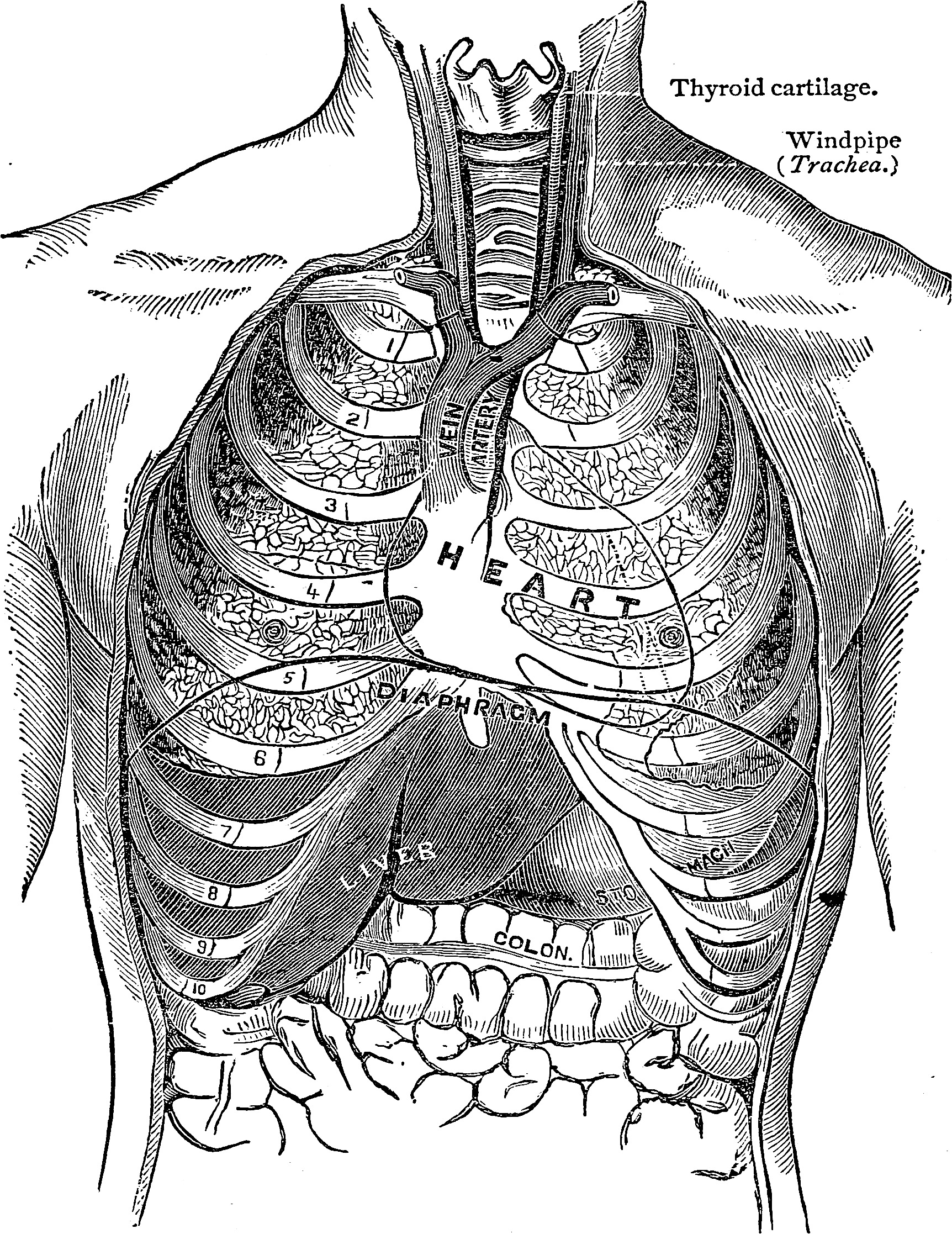
    Illustration of the organs of the thorax and upper abdomen from Frederick Garbit's 1880 <em> The woman's medical companion and guide to health</em>.
    Illustration of the organs of the thorax and abdomen from Johannes Sobotta's 1906 <em>Atlas and Text-book of Human Anatomy</em>

    The first illustration is from Frederick Garbit’s 1880 book The woman’s medical companion and guide to health. The second is from Johannes Sobatta’s 1906 Atlas of Human Anatomy. I cropped the latter so both illustrations would show roughly the same area.

    Now grab your favorite kid and play the game of: What’s different about these pictures? Here’s one hint: The guy on the right doesn’t have a heart, and part of his liver is missing. But this helps us see what is behind these structures. What else do you notice?

    The illustrator isn’t the only interpreter. Bodies are all different. We may have the same basic structure granted by evolution, but that structure is mediated by the genes we’re born with, and also by what we do throughout our lifetime: How we think and move, what we eat, our sleep patterns, how we manage our emotional lives and cope with stress, and what chemicals we introduce into the body, either willfully or involuntarily (those kids in Flint sure didn’t choose to drink lead-tainted water). The artist-anatomist is drawing someone’s body, and those bodies have their own unique stories to tell.

    So when you’re setting out to understand some aspect of anatomy, look at as many different illustrations as possible. After all, you wouldn’t claim to understand singing after listening to just one voice!

  3. Learning anatomy will not be very useful to you if it’s only theoretical.
  4. You need to start understanding it in your own body (and yes, this means you’re going to have to touch yourself). For instance, in this drawing, we can see that the dome of the diaphragm is roughly at the level of the fifth ribs, which I’ve highlighted in orange for you:
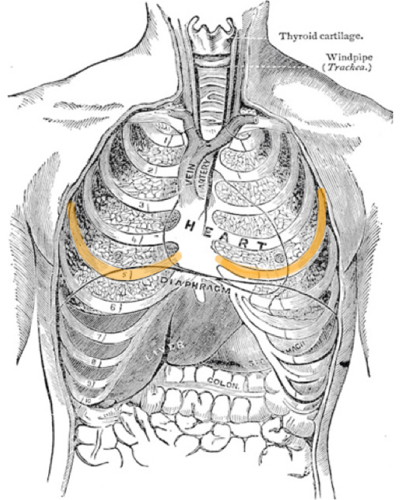
    Frederick Garbit illustration of the thorax showing the position of the fifth ribs.

    Have you ever tried counting your ribs and figuring out where that is? Start from the top of your chest, at either side of the sternum. The first rib is hard to feel, as it dives below the collar bones. The first set of ribs you will be able to clearly feel are your second ribs. Count down from there. Remember, always count your own ribs before assisting another passenger. Also, be patient. This is tricky, especially if you have big boobs. In the end, you may realize that the domes of your diaphragm (you have two – one on the right, one on the left) are higher than you thought.

  5. Sometimes you have to reorient the map to make sense of where you’re going.
  6. “What’s underneath the diaphragm?” You ask, as you’re working to expand your understanding of breathing. Perhaps you see this illustration and think: “Huh. The liver!”
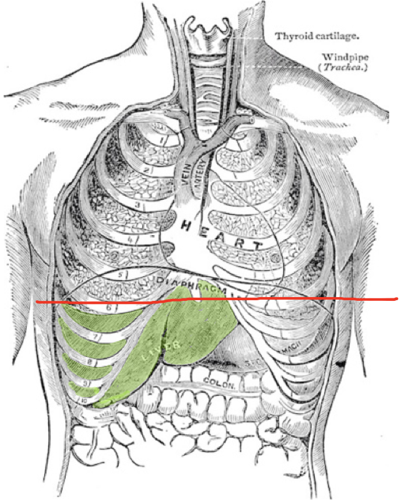
    Frederick Garbit illustration of thorax and abdomen, with the liver highlighted.
    “Huh. The liver! It’s green!”

    You decide to follow my suggestion from above and look at some different illustrations. Here’s one from Johannes Sobatta’s 1906 Atlas showing a cross-section of the abdomen. The red line in the above illustration shows the approximate level of the cross-section.

    Let’s just say that it’s the same guy as in the illustration above. We’re facing him, and we’ve just cut him in two, and now, still facing him, we’re looking down at the top edge of that slice.
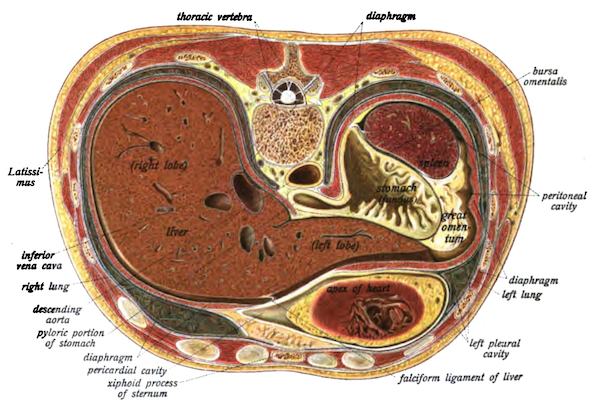
    A cross-section of the abdomen from Johannes Sobatta's 1906 <em>Atlas</em>.
    The front of the body is here.


    But honestly, we don’t care about this guy’s liver. We’re just trying to figure out our own, and to do so using this image, we’ll flip it around thusly:
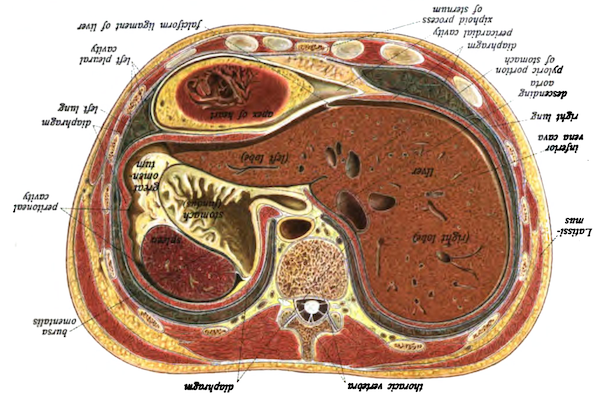
     

    Cross-section of the abdomen oriented to help you understand your own body.
    This edge is now the back of the body.


    Now the legends are all up-side down, but we can look at this cross-section and see that the liver is predominantly on the right (though it clearly crosses the mid line – basically, the liver is huge) and that the stomach and spleen are on the left. We see the vertebra at the back of the body. (It’s worth noting how much in the center of the body the “back” is.)

    Orienting the “map” this way makes it easier to use when we’re thinking about our own bodies.

    As a singer, I think about the liver a lot. Most don’t. So it’s only fair to offer another map-rotating example from a structure singers are more likely to think about, the larynx.

    The following illustration comes from the 1918 edition of Gray’s Anatomy. Because this material is in the public domain, you see it used all over the place, such as in Scott McCoy’s excellent book Your Voice: An Inside View. We can clearly see the vocal cords – chordae vocalis – at the center of the drawing. (These days, you’re more likely to hear them referred to as vocal folds.)
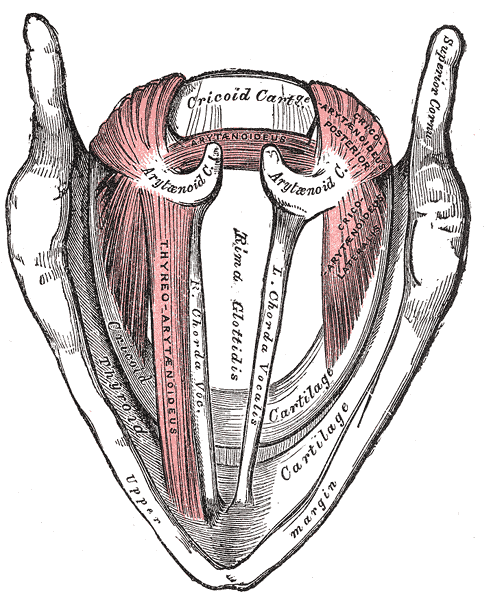
    Superior view of the larynx and vocal cords from <em>Gray's Anatomy</em>.
    Front of the body is here.


    The illustration, like the previously-discussed cross-section of the abdomen, shows the larynx from above, in someone we are facing (as if we’re the clinician about to shove a scope up the nose and down the throat to have a look).

    If I want to think about the larynx in my own body, I find it much more useful to look at the image thusly:


    Superior view of the larynx from <em>Gray's Anatomy</em> inverted to help us understand its position in our own bodies.
    This edge is now the back-of-the-neck side of the larynx.


    The inverted-V shape at the (now) top of the image is the front edge of the thyroid cartilage, which you can distinctly feel in your neck – your Adam’s apple.

  7. There is a downside to studying the dead to understand life.
  8. The living body moves.

    Life and movement are intertwined.

    The good news is that if you are reading this, you have a living specimen right to hand — yourself!

    We should let the many souls who have come before us — the artist-anatomists and those that contributed the bodies they studied (often without knowledge or consent) — be a source of inspiration for us. They have opened their bodies to us in a way we cannot (while living). Let’s be grateful to their contributions to the world of knowledge, and learn what we can from them.
Breathing, Holding, and Singing: A Primer on the Absurd

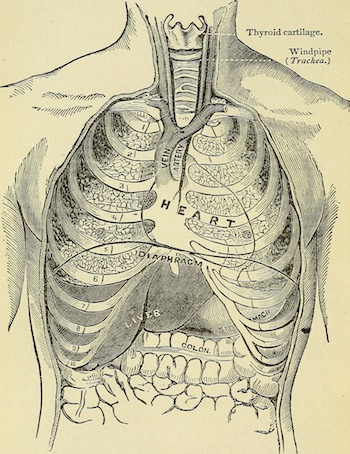
An illustration showing the diaphragm's position relative to the heart lungs (above) and abdominal muscles (below).
The diaphragm descends on the inhale, pulling on the lungs, which pull on the trachea, which pulls on the larynx. Illustration from Frederick Garbit’s (1880) The woman’s medical companion and guide to health.
When I teach breathing to singers, I tend to take a “try this and see what you feel” approach. I can’t clamber into anyone else’s body and feel what they’re feeling. In my view, it’s up to students to develop their own lexicon of sensations related to the breath. I can, at best, offer accurate information about different aspects of breathing: things to notice.

Like this: Start with an inhale. Your diaphragm descends, pulling your lungs and heart with it. Your lungs are connected to your trachea, which you can feel at the base of your neck, just above your sternum. Your trachea is connected to your larynx. On a deep inhale, you may be able to feel your larynx (Adam’s apple) move slightly downward. Notice. What happens when you start to speak or sing?

***

I like to collect odd instructions I’ve heard given to singers on the subject of breathing. Here’s one:

Lift your shoulders and hold them up so you can make more space for your lungs.

My lungs have always liked a little space, so while I’m at it, maybe I should get a bigger house? What the hell, maybe I should invade some other country so my lungs will have enough space!

Here’s another:

Squeeze your butt cheeks together and hold them so tight you couldn’t fit a tram ticket in there.

This one is clearly a partner exercise, with one person doing the cheek squeezing, and the other checking to make sure they can’t “fit the tram ticket in.” Don’t have a tram ticket? No worries. I’m sure your voice teacher can give you a business card to use instead.

And another:

Tense up your abdominal muscles as if someone is about to punch you and hold them there to support your singing.

Singing is, after all, very dangerous (especially if you’re invading other countries to make space for your lungs). You never know when someone might come along and punch you.

Okay, one more:

Inhale, let your ribs expand and hold them in this position for as long as possible on the exhale.

Hey, just as an experiment, why not try all four things at once? Lift your shoulders and give your lungs a little space. Tense up those buttocks, lest someone mistake you for a turnstile and try and “board your tram.” Inhale and expand your ribs. Tense up your abdominal muscles to support the exhale, and be sure keep your ribs out.

Ready to sing?

***

The above methods all have something in common: the injunction to hold.

When you hold, you are making something that should move static.

But breathing is dynamic. It involves movement of many bones, muscles, ligaments and organs. With all of these moving parts to organize, it’s no wonder the singer might sometimes take the rearranging-the-living-room-furniture approach to breathing: “Put this over here, that over there, and can you hold this picture up for me so I can see how it all looks?”

Let’s go back to noticing.

  1. Take a nice big inhale. Feel your rib cage expanding in all directions. (If you let your ribs move, you’ll probably find that your lungs have all the space they need!)
  2. Exhale on a sibilant [s] (hiss). The lungs are very elastic. If they weren’t anchored to the body wall, they’d crumple up into little balls. In a resting breath, we let this elasticity do most of the work of the exhale. See if you can sense this elastic recoil as you slowly exhale on the [s]. How long can you go without activating the abdominal muscles? (If you put your hands on your stomach, you should be able to feel when your abdominal muscles tense up.) Can you feel the movement of the exhale on all sides of your rib cage?
  3. On your next exhale, try singing one of the long-tone vocal function exercises, using just the elastic recoil of the lungs to provide the necessary air pressure. You won’t be able to sing the note as long, but it’s interesting to notice how much work the elastic recoil will do for you. (For me, this exercise has some of the qualities — such as ease and pleasure — of a sigh. An elongated sigh, mind you.)

    You cannot sing on the elastic recoil of the lungs alone. There has to be some balanced use of abdominal wall musculature. However, singers also need to learn to be able to feel the elastic recoil in the lung so they can tap into it, and let it do its share of the work.

Play with it. See what you notice.

Every breath is different.

Warming up the Voice with Vocal Function Exercises

Want to sing happily into your wise years? All the more reason to practice your vocal function exercises! Old Woman Singing by Dutch painter Gerard van Honthorst (1590-1656).
Imagine a different sort of violin. Rather than four strings, it has just one, and you don’t have to finger it to change the note. Instead, you must think the note; the string will automatically change its length and thickness to suit. The body of the violin is also continuously changing its shape as you play. Granted, this is awkward, but at least you only have one string to worry about!

Of course, what I’m trying to do here is imbue the violin with some of the qualities of the voice. The string of my one-stringèd violin represents the vocal folds, which vibrate to produce a tone. The body of the violin is the vocal tract, which adds resonance and amplification to the vibration so it can be heard on the other side of the hall. As for the other aspects of the voice, the breath, the articulators (mouth, tongue, lips, teeth — without which we’d have no consonants), I think I’ll hang up my hat on those rather than try and extend the analogy.

In short, the voice is a complicated instrument with a tremendous amount of variability in all of its parts. So how do you train the coordination between these parts?

Perhaps you do something to relax your body; to release tension in your neck, shoulders, and jaw, for example. Maybe you do something to warm up your breath. You might have a process to prepare yourself mentally, to clear the emotional detritus of your day. Perhaps — before you get down to the business of smoothing over your vocal galumphs with messe di voce exercises, with glides and vowel dances, with long tones and passage work — you engage in a ritual procrastination during which you clean the house, walk the dog, or “practice” yoga by lying in child’s pose and moaning1.

Enter my latest favorite warm-up: the Vocal Function Exercises developed by speech pathologist Joseph Stemple2 and colleagues3. As I understand it, their primary goal is to strengthen the muscles involved in phonation at the level of the larynx. Most recently, I’ve been using them to rehabilitate my voice after a month with bronchitis (which led to fantasies about next year’s Christmas CD: Meditations on Not Coughing). I’ve also found them very effective at improving the coordination between the breath, the vibration of the vocal folds, and the “placement” of the tone.

I will be honest: these exercises can be a little bit boring. But oh, the results! Give them a try.

Vocal Function Exercises

In the coming weeks, I will offer up some movement meditations I’ve used to keep myself engaged with these exercises. Because: the more mindful you can be in your practice, the more effective and transformative that practice will be. And variety is the spice of mindfulness!

The Chorister’s Lament: Why Your Feet Hurt So Much

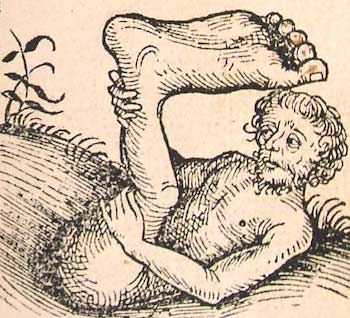
Monopod from the Nuremberg Chronicles.
The foot of the one-leggèd chorister hurts even more than those of us with two legs. This fellow is from a section of the 1493 Nuremberg Chronicles — written by Nuremberg doctor and humanist Hartman Schedel and illustrated by Michael Wolgemut and Wilhelm Pleydenwurff — describing odd peoples of the world.

I’m standing on my riser, shoulder to shoulder with my fellow choristers. During rehearsal, I thought we had a little more room; now it seems we have all become slightly swollen for the performance, and I cannot move in any direction without accidentally leaning on my neighbors. I am trying not to rest my music on the head of the person in front of me, and I can tell, by the regular rearrangement of my hair, that the person behind me is having a similar struggle. In spite of the fact that I’m wearing my ugliest and most comfortable black shoes, we’re only one song into the piece and already my feet hurt.

But when we expressed our concern during rehearsal about standing for so long, the director said: “Hey, I’m standing the whole time, too! Wear comfortable shoes.”

It is hard, at times like this, to keep my mind from wandering to thoughts of my new performance piece. It is written for 40 conductors and a single chorister. The chorister stands on a large, raised platform, where she has plenty of room to move around as the music demands. She has a stand so she doesn’t have to hold her music, and so she can give her full attention to the conductors. They stand on risers in front of her. Since there isn’t enough room to accommodate music stands, they are asked to hold their scores with one arm while conducting with the other. This obviously isn’t ideal, but fortunately there are enough of them to divvy up the task. One section conducts the beat. Another leads dynamic changes, and yet others are in charge of onsets and cut-offs. They can have a committee meeting later and decide who does what. In the meantime, conductors, please make sure you can see the chorister; you may have to shift a little to have clear sight lines. I realize it’s very crowded. Please do your best not to hit each other. This piece is 60 minutes long. Smile with your eyes!

If I were a better person, perhaps my hurting feet would not lead me so quickly into fantasies of vengeful performance art. Alas, I am deeply flawed. But here’s the thing: I spent years as a chorister trying to find shoes that were comfortable enough that my feet wouldn’t be in agony by the end of the concert. This was before I understood how the sensory receptors in the foot work.

We have sensory nerves (also called mechanoreceptors) throughout our bodies that send feedback to the brain about things like movement, pressure, and vibration. The feet have a lot of them.

One distinction that is made between these receptors is whether or not they are fast or slow adapting. Say, for instance, you get up in the morning and put on your shirt. The fast adapting sensory receptors in your arm will say: “Oh, hey, there’s a shirt!” They’ll send that signal to your brain for a short while, and then they’ll stop. Your brain really doesn’t need to be told all day that there’s a shirt rubbing against the skin of your arm. At the end of the day, when you take your shirt off, those same sensory receptors will fire again, and say: “Oh, hey, the shirt’s gone!”

Slow adapting sensory receptors, on the other hand, will continue to send a signal as long as the stimulus is present. This type of sensor is very important in the foot, because, among other things, it enables us to maintain our balance while standing and walking. If you’ve ever had the experience of trying to walk on a foot that’s “gone to sleep,” you know just how bad it can be when these sensory receptors go offline.

As choristers, when we are standing on risers, crowded enough that we can’t even shift our weight from one foot to another, the slow adapting sensory receptors in the foot will send a continuous signal to the brain, and before long, that message will be: “Ow. Ow. Ow. Ow. Hey, you’re still standing on me. Ow.” Comfortable shoes will help distribute the pain evenly over as much of the foot as possible, but they won’t do anything to change the essential nature of the mechanoreceptors in the foot.

The antidote? Movement.

In my fantasy piece, even though both the chorister and the conductors are standing for the same amount of time, the chorister’s feet don’t hurt. She has enough room to shift her weight from one foot to another without bumping into someone or having to worry about blocking the view for the people behind her. The conductors, on the other hand, crowded on their risers with no room to move, are starting to have trouble focusing on their music as their feet clamor for relief. They may start making silly mistakes, missing cues, or getting off of the beat.

So what’s a conscientious choir director to do?

  • A little extra space goes a long ways. When we shift our weight from one foot to the other, our whole body shifts so our weight is over the standing leg. Depending on the size and stance of the person, the head can easily shift between 4 and 8 inches to one side. That extra room means you won’t bump into your neighbor or block the view of the person behind you.

  • Got a big choir and not quite enough space? Gospel choirs have figured this one out! Everyone shifts from one foot to the other together. Sing some gospel tunes!

  • Got a big choir and not enough space and you’re not singing gospel music? I just invented a new notation for you! We notate breath marks and consonant placement for cut-offs in our music. Why not coordinated shifts from one foot to the other?

    New symbols to be added to the music notation lexicon, indicating weight distribution through left and right foot, respectively.
    New symbols to be added to the music notation lexicon, indicating weight distribution through left and right foot, respectively.

Singing in the Car

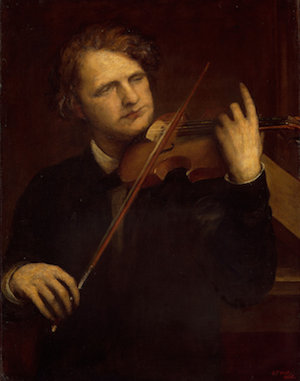
Painting of violinist Joseph Joachim by George Frederick Watts, 1868.
Famed 19th century violinist Joseph Joachim, who, among other things, premiered the Brahms violin concerto. I bet he didn’t practice in a horseless carriage! Painting by George Frederick Watts, 1868.

Once, in a conversation with the mother of a talented, but over-extended student — one who stacked up the extra-curricular activities like cordwood, as they say in Maine — I worried that my student didn’t have enough time to practice. The reply: “Oh, but she can practice in the car!”

Indeed, all that driving around: to chess club, riding lessons, violin lessons; to youth symphony rehearsals, piano lessons, Mandarin classes, and yes, voice lessons certainly gives a gal some quality time in the car. “But if she’s going to practice in the car,” I told her mother, “it should be violin.”

Needless to say, she looked at me like I was nuts. Come on! How are you supposed to practice violin while strapped in a car seat? How do you avoid continually jabbing the roof with your bow tip? Isn’t it a bad idea to have your instrument out in a moving vehicle, where any unconstrained item may turn into a projectile the moment things go south? And what about distraction? In 2013, roughly 512 people per day were involved in motor vehicle accidents in Minnesota. Just imagine how much worse it would be if we had a driving-while-fiddling epidemic!

Ah, but you say, “The voice is a hands-free instrument, perfectly suited to the car.”

In truth, I have nothing against singing in the car. I do it all the time. But I don’t practice there. For one thing, those bucket seats leave me feeling like I can barely breathe, as if my lungs were a bunch of rubber bands stuffed in a box. Second of all, the city where I live, like most cities around the world, is filled with people who spend way too much time in their cars. They hurtle around at high speeds; they’re late, they’re angry, and they’re right behind you. This may be a great time to belt out your favorite ditties, laced with expletives as people cut you off or tailgate, but is it really the time to transform your relationship with your voice?

But let’s forget the crazy drivers for a moment and go back to bucket seats and rubber bands.

Our bodies are filled with tissues with elastic qualities. What exactly does this mean?

Geza Peske painting of boys with a slingshot.
Imagining the potential of elasticity. An excerpt from Peske Geza’s work Zwei Buben mit Steinschleuder auf der Sommerwiese (Two Boys with Slingshot in the Summer Meadow), 1934.

When you stretch a rubber band, you are temporarily converting some of the movement energy you needed to stretch out the band into elastic potential. The band, when released, will return to its original shape, and in the process convert its elastic potential back into movement.

In our bodies, this interplay between movement driven by our muscles and movement driven by the elastic recoil of our connective tissues can make life a lot easier for us, if we’ll let it.

So where are these fabled rubber-band-like tissues of the body? Everywhere. Your ribs, for instance, will change their shape with a deep inhale, and then fuel part of the exhale with their elastic recoil. Feel it! Take a deep breath, and exhale on a hiss, without pushing. You’ll notice that you can exhale for quite a while before the abdominal muscles have to kick in. Thanks, elastic ribs!

Funny how we use elastic metaphors to describe the over-extended life. Someone who is stretched too thin might snap or even reach a breaking point. (Then perhaps she’ll rebound.) If you’re going to prime the great big rubber band that is your life, make sure you get to enjoy the recoil, the moment when you are flung across space in a way that seems effortless.

Meanwhile, practice in your body. You have an opportunity with every breath.