Monthly Archives: April 2015

Incremental Change

Two Scenes at Dusk

One

White pines in a twilight sky.
Twilight, by American painter Charles Warren Eaton (1857-1937). Painting c. 1900-1910.

I am running out the kitchen door one evening. Off the kitchen, steps lead down into the driveway. Those steps are for grown-ups. Us kids jump off the landing, grab onto the perfectly placed branch on the white pine growing next to the house — a dead branch whose top has been made smooth by innumerable such swingings — and propel ourselves as far into the world as possible. It is spring, and I am so intent on one of those essential kid errands that I nearly run into my mom, sitting quietly on the steps and looking out at the world. “Look!” She says. “It’s almost eight o’clock, and it’s not dark yet!”

Two

I am visiting a community in Colombia in the area near the border with Panama. I set out on a twilight errand. My time living close to the equator has taught me that there isn’t much to dusk. Unlike northern latitudes, where the light lingers after the sun has gone down, here, when the sun sets, it promptly gets dark, without ceremony or poetry. I can’t tell you how many times the equatorial sunset has caught me out in the dark… but not this evening! As I stride across a grassy field in the quickly-gathering dark, I am already wearing my headlamp. But when I turn it on, I am stopped in my tracks. Thousands of pinpricks of light magically appear on the ground before me. Intrigued, I squat down to inspect the source, and what I find is… spiders. The light of my headlamp is being reflected back to me by a constellation of spider eyes.

I offer this twilight diptych because for me, these two scenes reflect different aspects of a musical practice. On the one hand, there is incremental change and growth. No one sits down for their first piano lesson one day, and plays Rachmaninoff the next. But if we keep at it, there will be that moment when we look up and realize the days are a lot longer than they were a few months back.

At the same time, our practice can easily become habitual and inert. If I open one of my notebooks from my early years as a pianist, I see page after page of exercises, with injunctions from my teacher to “practice this every day.” If I could go back in time and supplement her instruction, I would tell myself: “See if you can practice this differently every day.”

The mind needs novelty to learn. Yes, we need a certain amount of repetition to get a skill into our bodies, but the perspective shift — like the light coming on and transforming a field of brown grass to a magical world of beautiful fellow creatures — is a powerful tool, an important skill to develop. Instead of “D major – 5x,” how about “D major, from five points of view.” Here are a few off the top of my head:

  1. Can you be aware of your breath as you play the scale?
  2. Sing along!
  3. Imagine the notes of the scale like drops of water falling into a pool; they sound at the moment of impact.
  4. Imagine your shoulders melting like ice cream as you play.
  5. Feel your feet on the floor. Imagine that in the room below you, there is a friendly giant. He taps you on the bottom of your feet and the vibration travels all the way up your body and through your arm and compels you to play each note of the scale.

I could go on, but I’m feeling the sudden urge to go practice!

Change your perspective.
The Chorister’s Lament: Why Your Feet Hurt So Much

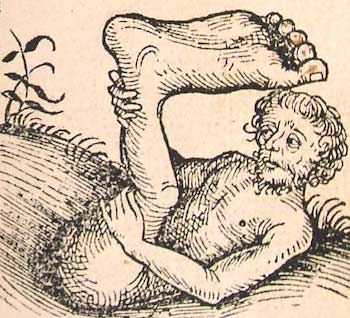
Monopod from the Nuremberg Chronicles.
The foot of the one-leggèd chorister hurts even more than those of us with two legs. This fellow is from a section of the 1493 Nuremberg Chronicles — written by Nuremberg doctor and humanist Hartman Schedel and illustrated by Michael Wolgemut and Wilhelm Pleydenwurff — describing odd peoples of the world.

I’m standing on my riser, shoulder to shoulder with my fellow choristers. During rehearsal, I thought we had a little more room; now it seems we have all become slightly swollen for the performance, and I cannot move in any direction without accidentally leaning on my neighbors. I am trying not to rest my music on the head of the person in front of me, and I can tell, by the regular rearrangement of my hair, that the person behind me is having a similar struggle. In spite of the fact that I’m wearing my ugliest and most comfortable black shoes, we’re only one song into the piece and already my feet hurt.

But when we expressed our concern during rehearsal about standing for so long, the director said: “Hey, I’m standing the whole time, too! Wear comfortable shoes.”

It is hard, at times like this, to keep my mind from wandering to thoughts of my new performance piece. It is written for 40 conductors and a single chorister. The chorister stands on a large, raised platform, where she has plenty of room to move around as the music demands. She has a stand so she doesn’t have to hold her music, and so she can give her full attention to the conductors. They stand on risers in front of her. Since there isn’t enough room to accommodate music stands, they are asked to hold their scores with one arm while conducting with the other. This obviously isn’t ideal, but fortunately there are enough of them to divvy up the task. One section conducts the beat. Another leads dynamic changes, and yet others are in charge of onsets and cut-offs. They can have a committee meeting later and decide who does what. In the meantime, conductors, please make sure you can see the chorister; you may have to shift a little to have clear sight lines. I realize it’s very crowded. Please do your best not to hit each other. This piece is 60 minutes long. Smile with your eyes!

If I were a better person, perhaps my hurting feet would not lead me so quickly into fantasies of vengeful performance art. Alas, I am deeply flawed. But here’s the thing: I spent years as a chorister trying to find shoes that were comfortable enough that my feet wouldn’t be in agony by the end of the concert. This was before I understood how the sensory receptors in the foot work.

We have sensory nerves (also called mechanoreceptors) throughout our bodies that send feedback to the brain about things like movement, pressure, and vibration. The feet have a lot of them.

One distinction that is made between these receptors is whether or not they are fast or slow adapting. Say, for instance, you get up in the morning and put on your shirt. The fast adapting sensory receptors in your arm will say: “Oh, hey, there’s a shirt!” They’ll send that signal to your brain for a short while, and then they’ll stop. Your brain really doesn’t need to be told all day that there’s a shirt rubbing against the skin of your arm. At the end of the day, when you take your shirt off, those same sensory receptors will fire again, and say: “Oh, hey, the shirt’s gone!”

Slow adapting sensory receptors, on the other hand, will continue to send a signal as long as the stimulus is present. This type of sensor is very important in the foot, because, among other things, it enables us to maintain our balance while standing and walking. If you’ve ever had the experience of trying to walk on a foot that’s “gone to sleep,” you know just how bad it can be when these sensory receptors go offline.

As choristers, when we are standing on risers, crowded enough that we can’t even shift our weight from one foot to another, the slow adapting sensory receptors in the foot will send a continuous signal to the brain, and before long, that message will be: “Ow. Ow. Ow. Ow. Hey, you’re still standing on me. Ow.” Comfortable shoes will help distribute the pain evenly over as much of the foot as possible, but they won’t do anything to change the essential nature of the mechanoreceptors in the foot.

The antidote? Movement.

In my fantasy piece, even though both the chorister and the conductors are standing for the same amount of time, the chorister’s feet don’t hurt. She has enough room to shift her weight from one foot to another without bumping into someone or having to worry about blocking the view for the people behind her. The conductors, on the other hand, crowded on their risers with no room to move, are starting to have trouble focusing on their music as their feet clamor for relief. They may start making silly mistakes, missing cues, or getting off of the beat.

So what’s a conscientious choir director to do?

  • A little extra space goes a long ways. When we shift our weight from one foot to the other, our whole body shifts so our weight is over the standing leg. Depending on the size and stance of the person, the head can easily shift between 4 and 8 inches to one side. That extra room means you won’t bump into your neighbor or block the view of the person behind you.

  • Got a big choir and not quite enough space? Gospel choirs have figured this one out! Everyone shifts from one foot to the other together. Sing some gospel tunes!

  • Got a big choir and not enough space and you’re not singing gospel music? I just invented a new notation for you! We notate breath marks and consonant placement for cut-offs in our music. Why not coordinated shifts from one foot to the other?

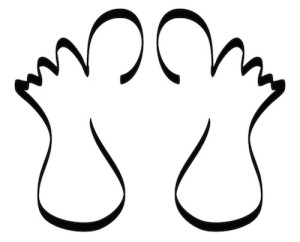
    New symbols to be added to the music notation lexicon, indicating weight distribution through left and right foot, respectively.
    New symbols to be added to the music notation lexicon, indicating weight distribution through left and right foot, respectively.