The kind of snow that promises a nice, quiet walk, come 2:00 am.One of the things I like about winter is that even in the city, you can find a kind of silence we rarely experience any more. Granted, you have to wait for a still, snowy night, stay up till two, and brave the chill of out-of-doors, but then you’ll have it; an urban silence, without traffic noise, without airplanes overhead, without snow-blowers or -shovelers, where the loudest sounds are those you make — of walking, fabric swishing, your breath.
For me, silence is a kind of holy space, and I would worship there more often if I could find it (and didn’t have to get in a car to do so). I’ve made an effort in the past couple of years to seek out a few out-of-the-way places so I might visit the church of silence. Included in this itinerary: the Valentine National Wildlife Refuge in the sand hills of Nebraska, Des Lacs National Wildlife Refuge in North Dakota, Bowdoin National Wildlife Refuge in Montana, and Grasslands National Park in Saskatchewan. Mostly, I’ve gone to listen, to have a break from the normal cacophony of my life. And I am very grateful to the governments that have set aside these spaces to preserve that which is increasingly rare; a place where non-human creatures and their habitats can get on with life unmolested, and where a gal like me can occasionally visit and humbly submit herself to the church of silence.
Of course, what I really mean by silence is the absence of sound from my own species.
There are all sorts of songs in this world, and many species singing them. One function of these songs is to claim territory, which is what seems to be going on in Oregon’s Malheur National Wildlife Reserve1. Our own invasive, highly territorial species has moved in and set about to crowing, as we are wont to do.
Maybe it’s time for us to shut up and see what we might have been missing.
Listen!
Recorded in Grasslands National Park, Saskatchewan, during an August sunrise. You’ll hear a variety of birds, distant lowing (bison), also-distant coyotes (with a real drama queen among them), and my squeaking boots, even though I’m trying my durndest to stand very quietly. I recommend headphones.
It all started with an appliance — an electric hair buzzer introduced into the household by someone wishing to economize on trips to the barber. Seeing it, I was struck by an old curiosity: what would it be like to shave my head? Some watts later, the deed was done, and if you’ve wondered why I utterly fell off the blogging wagon, it’s because I’ve been busy… being bald.
I don’t remember my bald baby days, or the grown-ups who gleefully snuffled my wee head. When I embarked on my bald adventures, I had no memory of the sensation of direct touch on the skin of my scalp — that touch was always mediated by my hair.
And wow, it’s different! Becoming suddenly bald was a bit like being given a new body part, and I wanted to take it everywhere (not that I really had any choice in the matter). I loved experiencing sensations like sun on my skin, rain, the temperature contrast between my hand and my head, the breeze, the breeze on my sweating head, the feeling of the pillowcase at night, or of my scalp moving under my hat when I’d wiggle my eyebrows.
There are downsides, of course. In the summer, the bald head is an irresistible canvas for the mosquito. Now that it’s cold, let me just say that it’s a good thing I’ve been knitting hats all these years.
I think that artistic growth (whether technical or expressive) comes when we are both ready and able to experience something in a novel way, with “happy new ears,” as John Cage would say. There is so much pleasure, discovery, and growth to be had in such novelty; you don’t even have to shave your head or grow a new limb to have the experience (but aren’t you just a little bit curious?). The novelty of my sudden baldness was not unlike the experiences I’ve had studying movement and anatomy; thinking, for instance, about my hip joint in a new way, or being able to visualize the workings of my shoulder, my jaw, the joint between the top of my spine and my skull.
For musicians, including singers, technical challenges are often movement challenges. The more advanced the skill level, the more likely you are to run into a limit caused by an excess of tension somewhere, a snag in the fabric of your structure that’s causing something to hang up. Sometimes, we even protect these snags; we get attached to them because we’ve worked hard to create them, and untangling them can seem like a threat to our hard-won expertise. If only shaving one’s head would solve these problems!
Happily, we all have our imaginations to hand, and can always put them to work helping us transform the way we occupy our own bodies (to paraphrase John Cage: She has an imagination; let her use it)2. In the coming weeks, I’ll be blogging about some of the ways I’ve used imagery to work with my own voice. I hope you’ll join me.
Twilight, by American painter Charles Warren Eaton (1857-1937). Painting c. 1900-1910.
I am running out the kitchen door one evening. Off the kitchen, steps lead down into the driveway. Those steps are for grown-ups. Us kids jump off the landing, grab onto the perfectly placed branch on the white pine growing next to the house — a dead branch whose top has been made smooth by innumerable such swingings — and propel ourselves as far into the world as possible. It is spring, and I am so intent on one of those essential kid errands that I nearly run into my mom, sitting quietly on the steps and looking out at the world. “Look!” She says. “It’s almost eight o’clock, and it’s not dark yet!”
Two
I am visiting a community in Colombia in the area near the border with Panama. I set out on a twilight errand. My time living close to the equator has taught me that there isn’t much to dusk. Unlike northern latitudes, where the light lingers after the sun has gone down, here, when the sun sets, it promptly gets dark, without ceremony or poetry. I can’t tell you how many times the equatorial sunset has caught me out in the dark… but not this evening! As I stride across a grassy field in the quickly-gathering dark, I am already wearing my headlamp. But when I turn it on, I am stopped in my tracks. Thousands of pinpricks of light magically appear on the ground before me. Intrigued, I squat down to inspect the source, and what I find is… spiders. The light of my headlamp is being reflected back to me by a constellation of spider eyes.
I offer this twilight diptych because for me, these two scenes reflect different aspects of a musical practice. On the one hand, there is incremental change and growth. No one sits down for their first piano lesson one day, and plays Rachmaninoff the next. But if we keep at it, there will be that moment when we look up and realize the days are a lot longer than they were a few months back.
At the same time, our practice can easily become habitual and inert. If I open one of my notebooks from my early years as a pianist, I see page after page of exercises, with injunctions from my teacher to “practice this every day.” If I could go back in time and supplement her instruction, I would tell myself: “See if you can practice this differently every day.”
The mind needs novelty to learn. Yes, we need a certain amount of repetition to get a skill into our bodies, but the perspective shift — like the light coming on and transforming a field of brown grass to a magical world of beautiful fellow creatures — is a powerful tool, an important skill to develop. Instead of “D major – 5x,” how about “D major, from five points of view.” Here are a few off the top of my head:
Can you be aware of your breath as you play the scale?
Sing along!
Imagine the notes of the scale like drops of water falling into a pool; they sound at the moment of impact.
Imagine your shoulders melting like ice cream as you play.
Feel your feet on the floor. Imagine that in the room below you, there is a friendly giant. He taps you on the bottom of your feet and the vibration travels all the way up your body and through your arm and compels you to play each note of the scale.
I could go on, but I’m feeling the sudden urge to go practice!
A punctual bird. Illustration from a 13th century bestiary.
Once, I lived in a place where I could set my watch by the twice-daily glimpse of a heron commuting across the sky: west to east at 10:30 every morning; home again at four. I like a punctual bird.
And I like to look at the sky. It’s easy to lose sight of. Maybe you work in an office or a cubicle with no window. Or you are tethered, by work or by habit (or both) to a different sort of window, the one that glows on your desktop or on the the smart phone in the palm of your hand. (And here, in fact, you are.) But take a moment and find a patch of sky and have a gander. No matter who you are, the sky is there for you, and the same sky looks down on us all. Hello.
A couple of months ago, I decided to experiment with practicing in the dark. It was still winter, when the electric lights come on early and stay on late; when one feels a wee bit justified spending too much time at the computer because it’s so cold out; and when, in spite of the long nights, I realized I was essentially living my waking hours in a world without darkness, where, thanks to Thomas Edison’s incandescence (and its descendants), my visual sense could lord it over all the others, all the darn day (and night) long.
Music must be so different to us now in this world without darkness.
I decided to try practicing across the twilight hour, without turning on the lights. I wanted to feel my senses shift roles, and my eyes did not give up their dominance easily. Even as it became too dim to see my music, they turned to the view out the window, to glimpse what light remained in the sky through a latticework of tree branches.
When you don’t turn on the lights at dusk, the room you’re in becomes very small, and for a while, it feels much darker inside than out. The darkening sky, on the other hand, stays big, dome like, present.
A view of the 15th century sky, from Les Echecs amoureux.
I like to think of my soft palate as being part of this dome, that when I inhale, it dissolves into the sky.
Do you know where your soft palate is? It’s part of the roof of your mouth, in the back. If you put the tip of your tongue behind your upper front teeth and move it back across the roof of your mouth, you’ll first feel the bony hard palate, covered with mucous membrane. At the back of where you can reach with your tongue, you’ll feel the beginning of the soft palate, where there is no bone directly beneath the surface. This highly mobile area is important for shaping the sound that comes from our larynx into language, both vowels, as well as some consonants. For example, say [k] as in cat; [g] as in gold. For these consonants, the back of the tongue comes up against the soft palate. If you say [i] as in see or [u] as in true, you might be able to feel the back of the tongue approximate (draw close to) the soft palate.
The soft palate creates a kind of mobile roof to the oropharynx, an area of the vocal tract which plays a crucial role in resonance, by which the sounds from the larynx are acoustically amplified.
In addition to helping shape and amplify language, the soft palate can open and close the passage between the nose and the throat. This happens, for instance, when you swallow, which is why (thank goodness) you don’t get food or liquid up your nose every time you swallow (unless someone tells you something really funny at just the right moment, and you suddenly find yourself guffawing, while coffee drips out your nose). This door to the nose also has to open when we make any kind of humming sound, such as the nasal consonants [m], [n], and [ŋ] (as in singing).
But at the end of the day, as singers and as persons of voice, the most important thing we do with our voices is communicate with others, and sometimes this can be scary. Perhaps it is performance anxiety. Perhaps a difficult conversation, or even a confrontation. At times like this, I like to expand my image of my soft palate dissolving into the dome of the sky to include all the other soft palates in the room.
Give it a try sometime. No one ever needs to know you’ve just recruited their soft palate to be part of your sky dome.
Let me tell you about the house in my imagination. You enter from any old closet. Make your way behind the hanging clothes. Find the small door. Get down on your hands and knees and crawl through; yes, it’s dark, but take courage! At the end, you find a door with an iron latch that leads to an attic under a peaked roof, with a window at the end letting in some light. There’s enough headroom in here for you to dust off your knees and stand up. In the middle of the floor is a staircase; follow it down a short flight, around a turn to the left, and you come into a large room with vaulted ceilings, filled with tables covered in old kitchen implements. The roof is a shambles, and vines drip down into the room from the missing sections; duck around them and take a gander at the stuff on the tables: Maybe you’ll find the perfect old teapot.
Once, a voice teacher, trying to help me develop my resonance, suggested that I imagine a huge house in the back of my head. “Right now, you’re just resonating in the kitchen,” she said. “Can you resonate in the whole house?”
She was asking me to call upon a mental image as a way of producing a change in my physical self-awareness, in my movement, and in my sound. Such mental imagery can be an incredibly powerful tool, and it’s one that all singers use. However, in order for it to be effective, it needs to be attached to real information about the body, and it has to be meaningful to you in a way that both makes your mind want to sit up and sniff the air, and is relevant to the movement change you want to make. My teacher’s suggested image of a “big house in the back” certainly caught my mind’s attention. Alas, she had no way of knowing that in my case this particular image would leave me crawling through secret passages and examining old spatulas. Metaphorical images like this one (there’s no actual house back there) are very personal. What works for one person may not work for another.
One of the challenges of working with the body is you can’t just look at things. You can’t, say, take apart your hip joint, as you would an old clock, in order to figure out what is twanging in there.
Luckily for us, other artists and scientists have been studying our insides for hundreds of years, cutting up the bodies of those who no longer need them, and in more recent years, developing non-invasive imaging technologies that can help us see inside the body in vivo. We can study this work to help us develop a clearer image of our own bodies, a repertory of anatomical imagery we can use to increase our sensory awareness, so we can learn to see with our minds the parts of our bodies we can’t see with our eyes.
So.
Let’s turn away from the table laden with old egg beaters and wooden spoons and see if we can develop an anatomical image of the oropharynx, the “big house in the back.”
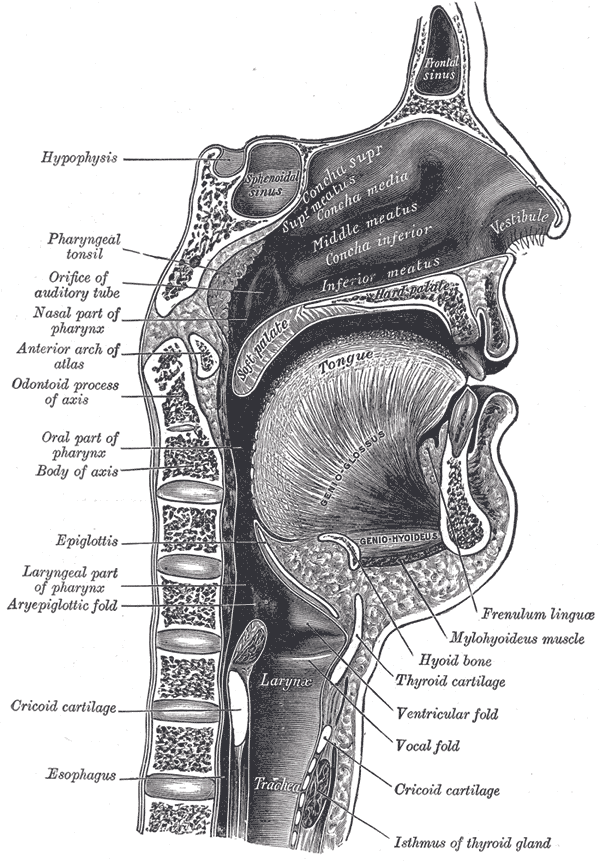
Oropharynx
The oropharynx is an important area of resonance for the voice, in the throat, behind the tongue. In this drawing, it is labeled (on the left) “oral part of the pharynx.”
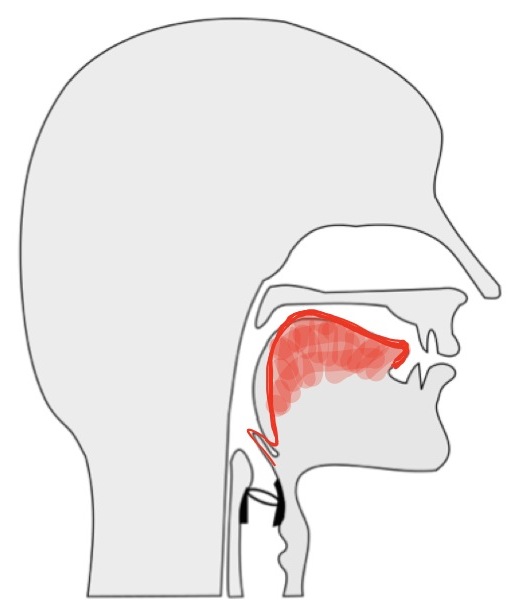
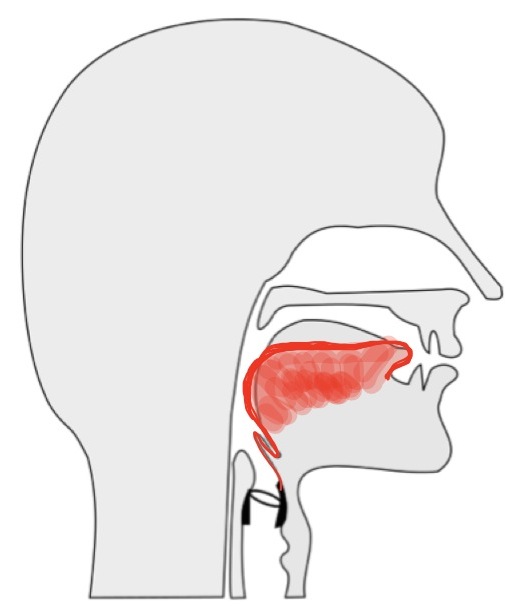
Some things to note: the tongue is a lot bigger than what you can see in the mouth. It forms the anterior (front) wall of the oropharynx, and its movement is part of how this entire area changes shape as we make different vowel sounds.
Vocal Tract from the 1918 Edition of Gray’s Anatomy.
Here I’ve drawn in the tongue position for the [i] (as in tree) and [a] (as in father) vowels respectively. You can see that in the oropharynx, the [i] vowel has the larger space. When the tongue is in the [a] position, it’s moving back towards the spine.
Tongue positions for the [i] as in tree and [a] as in father vowels.
For an in vivo demonstration, I recommend the following video made by the the good folks at the Speech Production and Articulation Knowledge Group at the University of Southern California School of Engineering. It shows a real-time MRI of the vocal tracts of two different singers, one trained in a European classical tradition, and the other a beat boxer. The classical singer performs “O mio babbino caro.” Note how the space in the oropharynx changes between the [i] of mio and the [a] of caro. We often think of the [a] vowel as being the most open, and in the oral cavity, it is. In the oropharynx, on the other hand, it is the most narrow vowel.
After last week’s post on Singing and Wine, you have perhaps been sniffing at the world in a different way. Using the process of smelling can also be a good way of increasing your proprioceptive sense of the oropharynx.
Picture the vocal tract and oropharynx in your mind. Then inhale through the nose, feeling the air move against the mucosal lining of the nose and throat. Famed vocal pedagogue Richard Miller has a nice version of this exercise in The Structure of Singing (page 62):
With lips closed, breathe through the nose as though slowly inhaling a pleasant aroma; maintain a pleasant expression on the face without actually smiling.
(Just to be contrary, I tried this exercise while sporting a grimace. It still works, though the expression on your face probably won’t help your singing.)
Rather than thinking of the oropharynx as a large space, which can lead students to try and make it yet bigger, by hook or unnecessary crook, I like to focus on just experiencing its existence, and how much it moves when I sing and speak.
So get thee to the oropharynx and try on a little vowel dance!
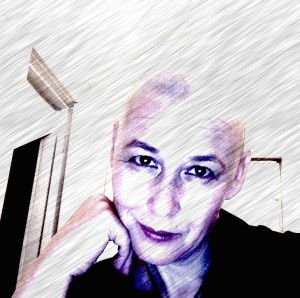 It all started with an appliance — an electric hair buzzer introduced into the household by someone wishing to economize on trips to the barber. Seeing it, I was struck by an old curiosity: what would it be like to shave my head? Some watts later, the deed was done, and if you’ve wondered why I utterly fell off the blogging wagon, it’s because I’ve been busy… being bald.