Monthly Archives: February 2016

Having a Voice in the World

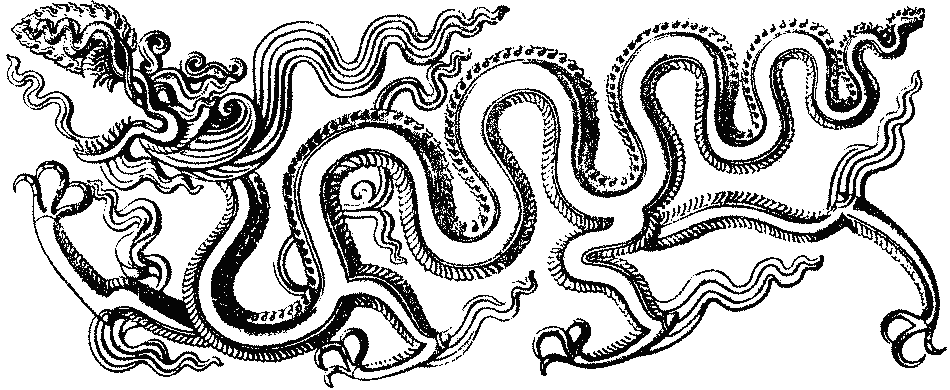
A Dragon like a River

A Minnesota Dragon

Once, there was a mighty dragon. He wasn’t just mighty, he was helpful. He had a great reputation as a stump puller, and was always a welcome guest on those soggy camping trips when no one else could get the fire going. Basically, he liked to be with, and he liked to help.

There came a summer with no rain. Crops wouldn’t grow, animals were dying of thirst, and everyone worried that there wouldn’t be enough to eat, come winter.

Sometimes, to have a voice in the world, you need many voices. I wrote and performed this fable in 2014, as part of a concert with VocalPoint Chorus. Each year, they choose a beneficiary organization. The choristers (currently 70 singers) spend weeks learning about the partner organization and its work, becoming living amplifiers — a singing, publicity machine — along the way. The process culminates with a fundraising concert. This year’s beneficiary is Upstream Arts.

Wind in our Sails: The Creative Art of Packing our Boats for the Upstream Journey

VocalPoint Chorus

February 27th & 28th, 2016

Central Presbyterian Church
500 Cedar Street
Downtown Saint Paul

Tickets & Information

The dragon saw all this. He hated to see people suffering, and so he did what dragons do when they worry; he scratched and fretted and sat on his haunches and chewed his toenails. Then he had an idea.

In those days, like now, there was a Great Committee. They lived in a big castle up on the hill, and if you wanted to get anything done, you had to get their permission, first. So the dragon went to the Committee: “If you can make me a big bucket,” he told them, “I will bring water for everyone.”

The men and women of the Committee hemmed and hawed. “I don’t have time to make a bucket,” said one. “I’m not sure everyone deserves water,” said another. “You know, if people were smart, they would have seen this coming and saved up their water,” said yet another.

You have to know that dragons are, as a rule, very patient. But after hours of listening to the Committee dickering back and forth, our dragon lost hope. He slumped away, feeling very sad.

When the dragon’s camping buddies realized they hadn’t seen him for a few days, they went looking. They found him crying at the bottom of a dried-up lake. (Dragons don’t cry tears, you know — they just spark. Our dragon had gone to the lake bed to cry so he wouldn’t accidentally set anything on fire. Like I said, he was considerate.)

“What’s wrong, Dragon?” asked one of the campers, a boy everyone called Small Paul.

“I need a bucket,” replied the Dragon. “And I can’t make it myself.” He waved his unwieldy claw.

“Well, that’s an easy problem to fix,” said Small Paul. “We learned how to make buckets last year at camp.”

“It needs to be a really big bucket,” said the Dragon.

So the campers gathered their supplies. One girl got some nice hickory sticks and bent them over a frame to make bucket ribs. Several campers ran to fetch as many hides as they could find. And then they all sat together, leaning on their friend the dragon for warmth. They waxed their threads, and started to sew.

They sewed until the sun went down, and then they sewed as the stars came out. They pricked their fingers many times as they pushed their needles through the tough hides. As the night wore on, and everyone started to get a little sore and cranky, Small Paul said to the Dragon: “You know, you may not have the opposable thumbs needed for sewing, but you can still sing to us. It will make the work go faster.”

Well, the dragon was very flattered. You probably don’t know this, but dragons love to sing, and if you’ve never heard one, it’s just because they’re very bashful about it. Many’s the time our dragon had found himself a lonely hilltop where he could try out his favorite ditties without being heard. But now! The campers had asked for a song, and he was, after all, a helpful dragon. So he cleared his throat. He made a little comment about how he really wasn’t a very good singer… but after a few warbles, he started to feel more confident, and he sang into the night as around him his friends sewed the biggest bucket in the world.

In the morning, the bucket was finally finished. It was so big, even the dragon worried he wouldn’t be able to carry it, once filled with water. But singing all night had given him courage. So he grabbed the handle in his talons, and lept into the sky. He flew to the great lake in the north — the lake that is so vast it never dries, even after months with no rain — and he brought the water back to his people, and they rejoiced.

Well, most of them rejoiced. Remember the Committee? “We had plans for this drought!” They said. “We were going to build a desert theme park! We’ve already lined up the corporate sponsorship and ordered the camels!”

Never underestimate the power of a committee unified in anger. “You want to bring water to the people?” They cried. “So be it!” And they raised their arms and called out an incantation. A great rumbling filled the air, so loud that everyone crouched down and covered their heads. When all was finally quiet again, the people rose and discovered that, in an act of unprecedented bipartisanship, the Great Committee had turned their friend the dragon into a mighty river. Nothing was left of him but a single scapula. “People, you shall have your water,” said the Committee. “May it ever divide you!”

But remember Small Paul? He stood at the banks of the river and looked at the bucket, and then looked at the scapula of his friend the dragon. You know what a scapula is, right? It’s your shoulder blade. Dragons have them, too. It’s a big, flat bone, and a dragon scapula makes a perfect paddle.

Small Paul turned to the man beside him: “Hey,” he said. “You wanna cross the river? For two feathers and an apple, my friends and I will take you across in our boat.” So they hopped in the bucket and all the campers took turns paddling across to the other side. And when they got there, they built a big bonfire along the banks and spent the night singing and dancing for their friend the dragon.
Thinking Beyond the Soft Palate: Vibrating the Sella Turcica

The voice needs a core. I’ve always thought of this core as a pointy little sound that happens somewhere in the middle of my head. One can, of course (and should), build something bigger around this core, but first the voice needs a steady hearth to live by. As famed vocal pedagogue Giovanni Lamperti put it:

Not until the focus of voice is like a fixed star in your head, kept in position by the powers inside and outside your body, can you sing1.

Finding this core to the sound is part of the process of developing resonance, and like many aspects of vocal technique, involves improving your ability to perceive — to feel — what is going on in your body.

One of the relevant areas is the soft palate, the part of the roof of your mouth behind the bony hard palate. This area moves a lot during phonation, and there is generally much talk about what you should be doing with it while singing. I have no intention of addressing the issue here. Instead, I want to talk about using the sensation of vibration in the bone above the soft palate as a meditation for resonance.

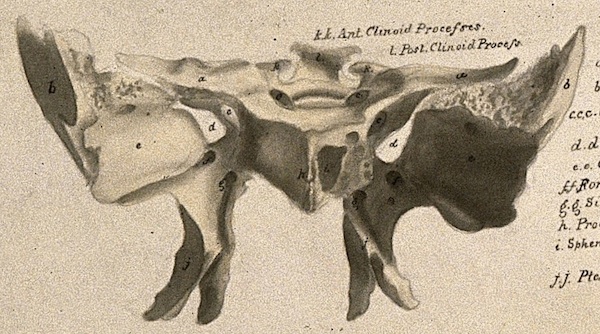
Some weeks ago, I talked about the idea of movement between the different bones of the skull, specifically looking at the maxilla, which holds the upper teeth, and forms most of the hard palate. Today’s bone-for-reflection, which hovers above the soft palate and the nasopharynx, is arguably the most beautifully-shaped bone in the body: the sphenoid.

Anterior view of the sphenoid
Is it a bird? Is it a moth? No! It’s an anterior view of the sphenoid! Illustration from an unknown work on anatomy, circa 1830. Image credit: Wellcome Library, London.

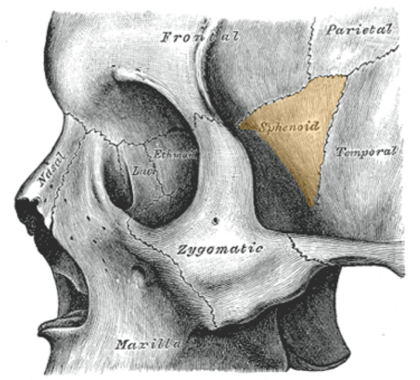
Most of the surfaces of the sphenoid are inaccessible to touch. We can feel its greater wings at the temples, just behind the outer edges of the eye sockets:

View of the side of the skull showing the location of the sphenoid bone at the temple.

(We can also touch its insect-leg-like hamular process inside the mouth, but you’ll have to ask your friendly craniosacral therapist for help with that one.)

The part of the sphenoid I want to focus on for the moment is a structure which lies directly above the soft palate called the sella turcica, and yes, that means “Turkish saddle.” It’s a cradle of bone on the inside floor of the skull which rocks the pituitary gland.

A Turkish saddle, high in the front and back, just like our friendly pituitary cradle. Illustration by Sir Henry Austen Layard: Nineveh and Babylon, 1882.

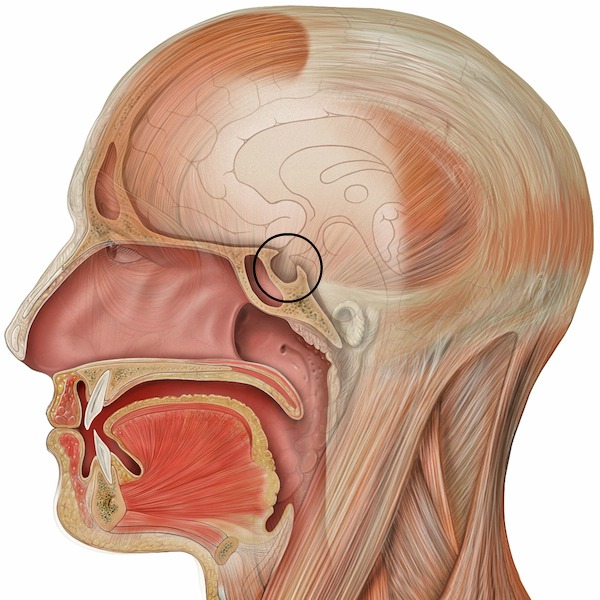
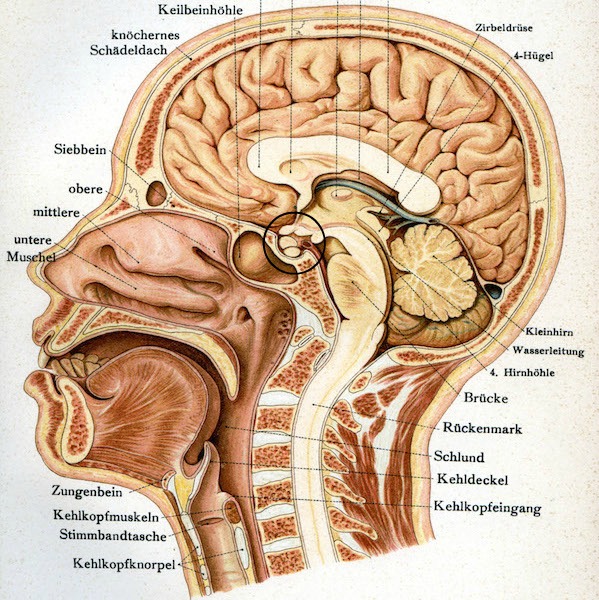
And because you should never look at just one anatomical illustration if you can look at five, I offer three public-domain images showing the location of the sella turcica in a sagittal view of the head (get thee to the interwebs if you want to find more).

This first image is from the ubiquitous Gray’s Anatomy. The sella turcica is circled, and labeled “Hypophisis” by the illustrator. Hypophisis is another word for the pituitary gland, which rests in the bony cradle.
Sella Turcica from Gray's Anatomy


In this second illustration by Patrick Lynch (made in collaboration with Carl Jaffe, MD, cardiologist), we can see the pituitary hanging down into the sella turcica. Note the structure’s position relative to the soft palate and oropharynx.

Sella Turcica by Patrick Lynch


This third image is from a 1910 German Anatomy Textbook, Der ärztliche Ratgeber in Bild und Wort. Atlas und Hausbuch für Gesunde und Kranke. Here, you can also see the pituitary, looking like a couple of little eggs nestled into the Turkish saddle.

Sella Turcica from German Anatomy Textbook


I like to think of vibrating the sella turcica, because for me the sensation of vibration in the area brings more awareness to the soft palate.

  1. To help imagine its location, place your finger at the top of your nose, at the bottom of the forehead. This is roughly the level of the sella turcica. Imagine a line going straight back from here.
  2. Find the outside edges of your eye sockets. Move your fingers back from here about an inch. Your fingers will now be on your temples, perhaps in the vicinity of your hairline (unless, like me, you’re bald). Imagine a line going through your skull, between your fingers. This line intersects the sella turcica
  3. Move your fingers back and forth between these two imaginary lines. Can you visualize where they intersect? As you do this, hum or sing a soft note, making sure you try different pitches and registers. Can you feel vibration in this area?

Give it try! Perhaps while you’re practicing your Vocal Function Exercises!

Anatomy and Interpretation: What the Singer should Know

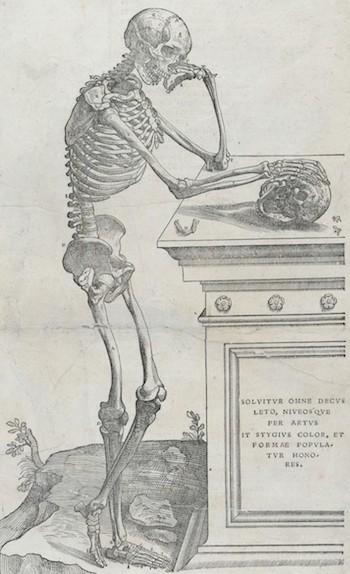
Skeleton from Andreas Vesalius' De humani corporis fabrica, published in 1543. The words on the tomb are from Silius Italicus' epic poem Punica, and reads: "Death robbed him of all his beauty: a Stygian hue spread over his snow-white skin and destroyed his comeliness." (Translated by J.D. Duff.) Image courtesy of the Wellcome Library, London.
Skeleton from Andreas Vesalius’ De humani corporis fabrica, published in 1543. The words on the tomb are from Silius Italicus’ epic poem Punica, and reads: “Death robbed him of all his beauty: a Stygian hue spread over his snow-white skin and destroyed his comeliness.” (Translated by J.D. Duff.) Image courtesy of the Wellcome Library, London.
The study of anatomy is as much art as science. And, though it depends on death — specifically, the cutting open of dead bodies — it has striven, from its earliest days, to show life. Take, for instance, this image from Andreas Vesalius’ De humani corporis fabrica (On the construction of the human body). No mere skeleton, this! He leans on a tomb (his own?) and gazes (despondently? pensively?) at another skull. Meanwhile, his bones are all neatly labeled so we can look them up in the accompanying legend.

I encourage singers to learn anatomy. (Actually, I think everyone should learn anatomy.) Luckily for us, we live in a time of unprecedented access to information, and it’s relatively easy to find good anatomical illustrations to aid you along the way. There are anatomy apps for smart phones and tablets, videos to watch on the interwebs, and even websites where you can look at 3-D illustrations that can be moved hither and thither with the flick of a mouse. Imaging technology such as real-time MRI has advanced so we can even see films made of the body in vivo.

Before you set out, there are a few things the intrepid singing student of anatomy should bear in mind.

  1. Anatomical illustrations are interpretations.
  2. Singers are familiar with the idea of interpretation, of course. Even though the “bones” of a song remain the same, the performance can vary enormously from one singer to the next.

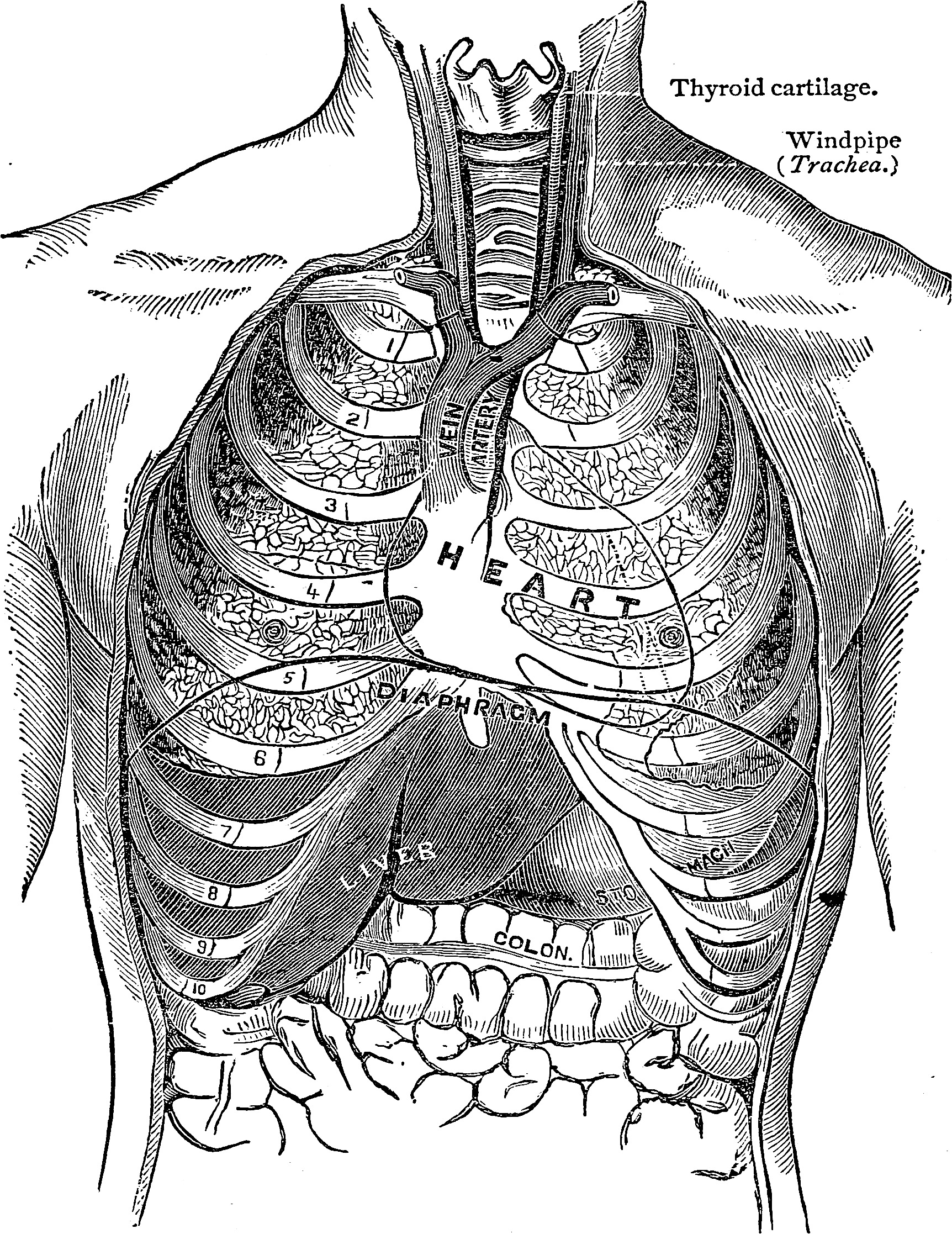
    For the artist-anatomist, interpretation involves things like choosing media, figuring out how to show a three-dimensional form in two dimensions, deciding how to “edit the body for clarity” — what structures to include and what to leave out. For instance, here are two pictures of the thorax and upper abdomen showing the organs (click on the image if you want to download the full-size version and do some coloring):

    Illustration of the organs of the thorax and upper abdomen from Frederick Garbit's 1880 <em> The woman's medical companion and guide to health</em>.
    Illustration of the organs of the thorax and abdomen from Johannes Sobotta's 1906 <em>Atlas and Text-book of Human Anatomy</em>

    The first illustration is from Frederick Garbit’s 1880 book The woman’s medical companion and guide to health. The second is from Johannes Sobatta’s 1906 Atlas of Human Anatomy. I cropped the latter so both illustrations would show roughly the same area.

    Now grab your favorite kid and play the game of: What’s different about these pictures? Here’s one hint: The guy on the right doesn’t have a heart, and part of his liver is missing. But this helps us see what is behind these structures. What else do you notice?

    The illustrator isn’t the only interpreter. Bodies are all different. We may have the same basic structure granted by evolution, but that structure is mediated by the genes we’re born with, and also by what we do throughout our lifetime: How we think and move, what we eat, our sleep patterns, how we manage our emotional lives and cope with stress, and what chemicals we introduce into the body, either willfully or involuntarily (those kids in Flint sure didn’t choose to drink lead-tainted water). The artist-anatomist is drawing someone’s body, and those bodies have their own unique stories to tell.

    So when you’re setting out to understand some aspect of anatomy, look at as many different illustrations as possible. After all, you wouldn’t claim to understand singing after listening to just one voice!

  3. Learning anatomy will not be very useful to you if it’s only theoretical.
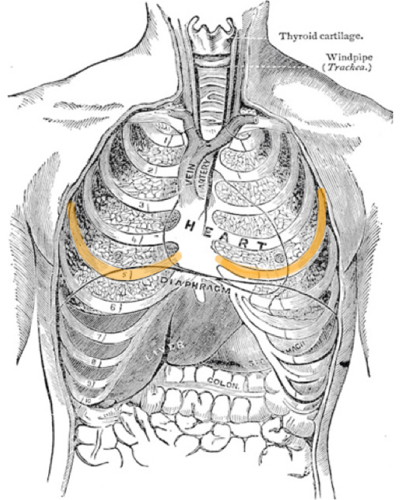
  4. You need to start understanding it in your own body (and yes, this means you’re going to have to touch yourself). For instance, in this drawing, we can see that the dome of the diaphragm is roughly at the level of the fifth ribs, which I’ve highlighted in orange for you:

    Frederick Garbit illustration of the thorax showing the position of the fifth ribs.

    Have you ever tried counting your ribs and figuring out where that is? Start from the top of your chest, at either side of the sternum. The first rib is hard to feel, as it dives below the collar bones. The first set of ribs you will be able to clearly feel are your second ribs. Count down from there. Remember, always count your own ribs before assisting another passenger. Also, be patient. This is tricky, especially if you have big boobs. In the end, you may realize that the domes of your diaphragm (you have two – one on the right, one on the left) are higher than you thought.

  5. Sometimes you have to reorient the map to make sense of where you’re going.
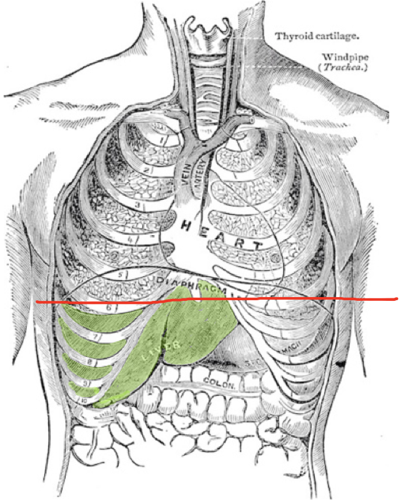
  6. “What’s underneath the diaphragm?” You ask, as you’re working to expand your understanding of breathing. Perhaps you see this illustration and think: “Huh. The liver!”

    Frederick Garbit illustration of thorax and abdomen, with the liver highlighted.
    “Huh. The liver! It’s green!”

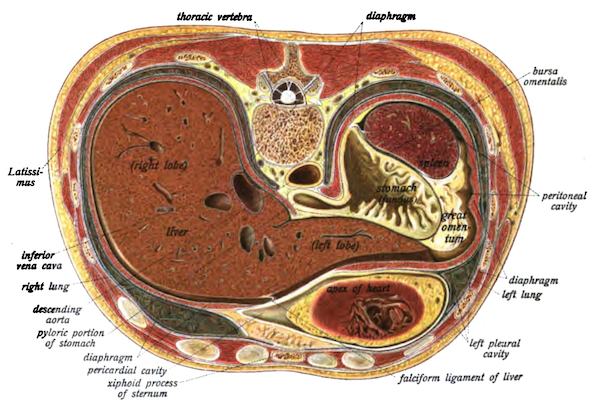
    You decide to follow my suggestion from above and look at some different illustrations. Here’s one from Johannes Sobatta’s 1906 Atlas showing a cross-section of the abdomen. The red line in the above illustration shows the approximate level of the cross-section.

    Let’s just say that it’s the same guy as in the illustration above. We’re facing him, and we’ve just cut him in two, and now, still facing him, we’re looking down at the top edge of that slice.

    A cross-section of the abdomen from Johannes Sobatta's 1906 <em>Atlas</em>.
    The front of the body is here.


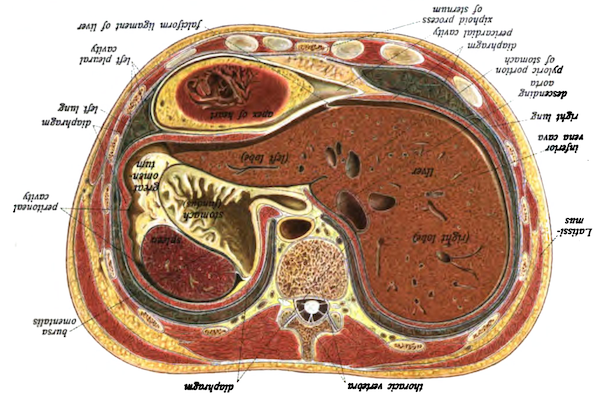
    But honestly, we don’t care about this guy’s liver. We’re just trying to figure out our own, and to do so using this image, we’ll flip it around thusly:


    Cross-section of the abdomen oriented to help you understand your own body.
    This edge is now the back of the body.


    Now the legends are all up-side down, but we can look at this cross-section and see that the liver is predominantly on the right (though it clearly crosses the mid line – basically, the liver is huge) and that the stomach and spleen are on the left. We see the vertebra at the back of the body. (It’s worth noting how much in the center of the body the “back” is.)

    Orienting the “map” this way makes it easier to use when we’re thinking about our own bodies.

    As a singer, I think about the liver a lot. Most don’t. So it’s only fair to offer another map-rotating example from a structure singers are more likely to think about, the larynx.

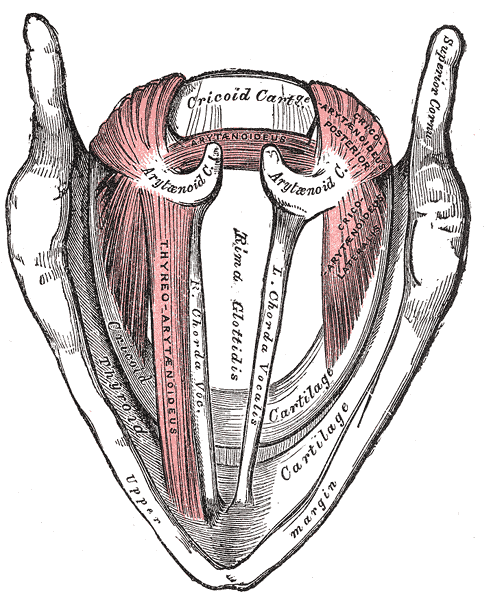
    The following illustration comes from the 1918 edition of Gray’s Anatomy. Because this material is in the public domain, you see it used all over the place, such as in Scott McCoy’s excellent book Your Voice: An Inside View. We can clearly see the vocal cords – chordae vocalis – at the center of the drawing. (These days, you’re more likely to hear them referred to as vocal folds.)

    Superior view of the larynx and vocal cords from <em>Gray's Anatomy</em>.
    Front of the body is here.


    The illustration, like the previously-discussed cross-section of the abdomen, shows the larynx from above, in someone we are facing (as if we’re the clinician about to shove a scope up the nose and down the throat to have a look).

    If I want to think about the larynx in my own body, I find it much more useful to look at the image thusly:


    Superior view of the larynx from <em>Gray's Anatomy</em> inverted to help us understand its position in our own bodies.
    This edge is now the back-of-the-neck side of the larynx.


    The inverted-V shape at the (now) top of the image is the front edge of the thyroid cartilage, which you can distinctly feel in your neck – your Adam’s apple.

  7. There is a downside to studying the dead to understand life.
  8. The living body moves.

    Life and movement are intertwined.

    The good news is that if you are reading this, you have a living specimen right to hand — yourself!

    We should let the many souls who have come before us — the artist-anatomists and those that contributed the bodies they studied (often without knowledge or consent) — be a source of inspiration for us. They have opened their bodies to us in a way we cannot (while living). Let’s be grateful to their contributions to the world of knowledge, and learn what we can from them.