Monthly Archives: January 2016

Breathing, Holding, and Singing: A Primer on the Absurd

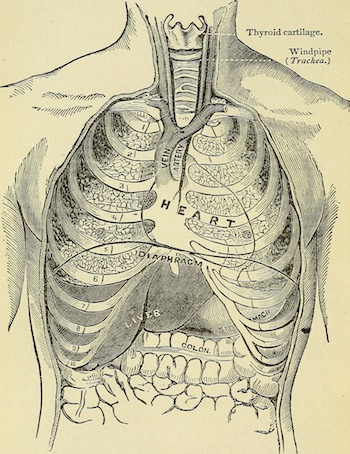
An illustration showing the diaphragm's position relative to the heart lungs (above) and abdominal muscles (below).
The diaphragm descends on the inhale, pulling on the lungs, which pull on the trachea, which pulls on the larynx. Illustration from Frederick Garbit’s (1880) The woman’s medical companion and guide to health.
When I teach breathing to singers, I tend to take a “try this and see what you feel” approach. I can’t clamber into anyone else’s body and feel what they’re feeling. In my view, it’s up to students to develop their own lexicon of sensations related to the breath. I can, at best, offer accurate information about different aspects of breathing: things to notice.

Like this: Start with an inhale. Your diaphragm descends, pulling your lungs and heart with it. Your lungs are connected to your trachea, which you can feel at the base of your neck, just above your sternum. Your trachea is connected to your larynx. On a deep inhale, you may be able to feel your larynx (Adam’s apple) move slightly downward. Notice. What happens when you start to speak or sing?

***

I like to collect odd instructions I’ve heard given to singers on the subject of breathing. Here’s one:

Lift your shoulders and hold them up so you can make more space for your lungs.

My lungs have always liked a little space, so while I’m at it, maybe I should get a bigger house? What the hell, maybe I should invade some other country so my lungs will have enough space!

Here’s another:

Squeeze your butt cheeks together and hold them so tight you couldn’t fit a tram ticket in there.

This one is clearly a partner exercise, with one person doing the cheek squeezing, and the other checking to make sure they can’t “fit the tram ticket in.” Don’t have a tram ticket? No worries. I’m sure your voice teacher can give you a business card to use instead.

And another:

Tense up your abdominal muscles as if someone is about to punch you and hold them there to support your singing.

Singing is, after all, very dangerous (especially if you’re invading other countries to make space for your lungs). You never know when someone might come along and punch you.

Okay, one more:

Inhale, let your ribs expand and hold them in this position for as long as possible on the exhale.

Hey, just as an experiment, why not try all four things at once? Lift your shoulders and give your lungs a little space. Tense up those buttocks, lest someone mistake you for a turnstile and try and “board your tram.” Inhale and expand your ribs. Tense up your abdominal muscles to support the exhale, and be sure keep your ribs out.

Ready to sing?

***

The above methods all have something in common: the injunction to hold.

When you hold, you are making something that should move static.

But breathing is dynamic. It involves movement of many bones, muscles, ligaments and organs. With all of these moving parts to organize, it’s no wonder the singer might sometimes take the rearranging-the-living-room-furniture approach to breathing: “Put this over here, that over there, and can you hold this picture up for me so I can see how it all looks?”

Let’s go back to noticing.

  1. Take a nice big inhale. Feel your rib cage expanding in all directions. (If you let your ribs move, you’ll probably find that your lungs have all the space they need!)
  2. Exhale on a sibilant [s] (hiss). The lungs are very elastic. If they weren’t anchored to the body wall, they’d crumple up into little balls. In a resting breath, we let this elasticity do most of the work of the exhale. See if you can sense this elastic recoil as you slowly exhale on the [s]. How long can you go without activating the abdominal muscles? (If you put your hands on your stomach, you should be able to feel when your abdominal muscles tense up.) Can you feel the movement of the exhale on all sides of your rib cage?
  3. On your next exhale, try singing one of the long-tone vocal function exercises, using just the elastic recoil of the lungs to provide the necessary air pressure. You won’t be able to sing the note as long, but it’s interesting to notice how much work the elastic recoil will do for you. (For me, this exercise has some of the qualities — such as ease and pleasure — of a sigh. An elongated sigh, mind you.)

    You cannot sing on the elastic recoil of the lungs alone. There has to be some balanced use of abdominal wall musculature. However, singers also need to learn to be able to feel the elastic recoil in the lung so they can tap into it, and let it do its share of the work.

Play with it. See what you notice.

Every breath is different.
What Once Was Solid

Ah, January!

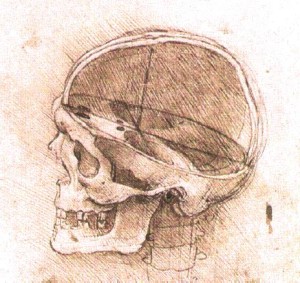
Skull detail by Leonardo da Vinci
Leonardo grabs his skull and hoofs it on over to winter.
If you’re north enough, you’ve taken to shoveling your water into piles, and if you live in an old and drafty place like I do, Jack Frost comes in the night and decorates your windows with one-of-a-kind works of art. January in the north is when everything gets cold and hardens. What better time to think about things we perceive as solid? So grab hold of that hard head of yours, and let’s take a moment to talk about the skull.

Seattle poet Greta Nintzel sometimes calls the skull a “calcium cage.” Until recently, I admired the phrase as an apt description for my own noggin’: a bony container for the wizard running my body machine.

Enter the craniosacral therapist. She put her hands on my head and made the subtlest of movements. I started to think: maybe I’m not as hard-headed as I thought.

Craniosacral therapy is based (in part) on the idea that the bones of the skull retain some amount of movement at the sutures where they grow together during development1. I have a picture in my mind of the half-baked, developing skull as a group of islands, slowly expanding towards one another until they can start to merge together, first as continents, and then as a whole, head-shaped planet.

Before the craniosacral therapist put her hands on my skull, I had no thought of there being movement in the skull itself, my oh-so-solid calcium cage. And now? I think of the bones as having slightly lubricated edges, as if they are moored to one another on the sea of my gray matter, bobbing and floating (while I dreamily listen to the halyards slapping against the mast).

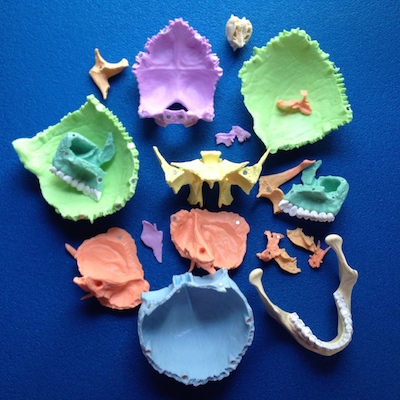
There is some disagreement on what should or shouldn’t be counted in this bony island archipelago, but for our purposes, let’s say there are 22 bones of the skull, as in this disarticulated model (Legos for anatomy geeks):

Disarticulated Skull

 
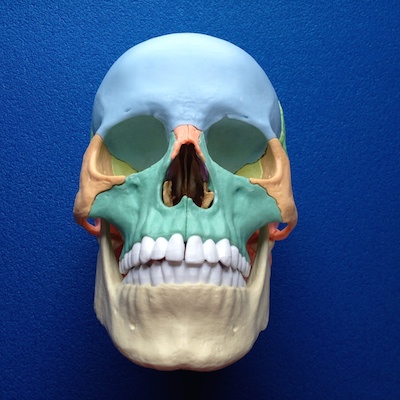
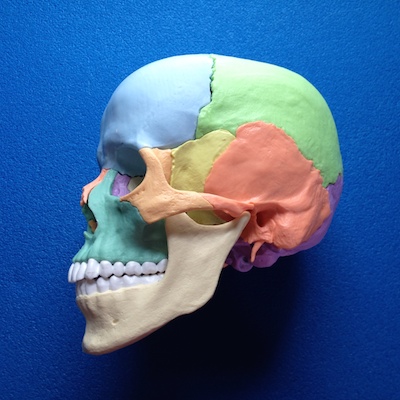
And here it is again, put back together:

skull model anterior view
skull model sagittal view


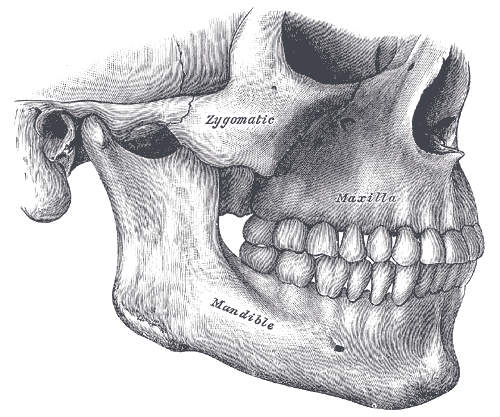
Among all these, I want to draw your attention to the maxillary bones, which are just below the nasal opening (teal in the images above). They hold your upper teeth and provide most of the surface of your hard palate. Here is another image from the 1918 edition of Gray’s Anatomy:

Maxilla from Gray's Anatomy


Previously, I introduced you to Joseph Stemple’s Vocal Function Exercises, and promised some things to contemplate while practicing them. So let’s vibrate the maxilla.

  1. As you hum, see if you can sense vibration in this bone (try different pitches). It’s easy to palpate its location, through the skin and muscles of your face, and also inside your mouth. If you feel the midline of your hard palate with your tongue, you can probably find the seam where the two halves of the maxilla join together. Can you feel the hum vibrating in different areas of the bone and in your upper teeth?
  2. The roof of your mouth is also the floor of your nose. Inhale slowly through your nose. Can you use the sensation of air coming in to help you sense the top (superior aspect) of the maxilla? What happens if you think of the hard palate widening slightly with the inhale?
  3. In the Vocal Function Exercises, we learned to sing long-tones on what I call the [o] inside an [u] vowel. Here, once again, is an example of the vowel:


    Because the embouchure of the closed [u] vowel is so tight, it can be tiring to hold the position for the duration of the exercise. To counter this, I like to imagine I can relax my upper teeth, as if I’m “letting them go”, and let them buzz in their sockets a little.

And hey, once you’ve vibrated the maxilla, we’ve only 20 bones to go in our vibratory exploration of the bones of the skull (the maxilla counts as two bones, with left and right halves).

Have fun!

Warming up the Voice with Vocal Function Exercises

Want to sing happily into your wise years? All the more reason to practice your vocal function exercises! Old Woman Singing by Dutch painter Gerard van Honthorst (1590-1656).
Imagine a different sort of violin. Rather than four strings, it has just one, and you don’t have to finger it to change the note. Instead, you must think the note; the string will automatically change its length and thickness to suit. The body of the violin is also continuously changing its shape as you play. Granted, this is awkward, but at least you only have one string to worry about!

Of course, what I’m trying to do here is imbue the violin with some of the qualities of the voice. The string of my one-stringèd violin represents the vocal folds, which vibrate to produce a tone. The body of the violin is the vocal tract, which adds resonance and amplification to the vibration so it can be heard on the other side of the hall. As for the other aspects of the voice, the breath, the articulators (mouth, tongue, lips, teeth — without which we’d have no consonants), I think I’ll hang up my hat on those rather than try and extend the analogy.

In short, the voice is a complicated instrument with a tremendous amount of variability in all of its parts. So how do you train the coordination between these parts?

Perhaps you do something to relax your body; to release tension in your neck, shoulders, and jaw, for example. Maybe you do something to warm up your breath. You might have a process to prepare yourself mentally, to clear the emotional detritus of your day. Perhaps — before you get down to the business of smoothing over your vocal galumphs with messe di voce exercises, with glides and vowel dances, with long tones and passage work — you engage in a ritual procrastination during which you clean the house, walk the dog, or “practice” yoga by lying in child’s pose and moaning2.

Enter my latest favorite warm-up: the Vocal Function Exercises developed by speech pathologist Joseph Stemple3 and colleagues4. As I understand it, their primary goal is to strengthen the muscles involved in phonation at the level of the larynx. Most recently, I’ve been using them to rehabilitate my voice after a month with bronchitis (which led to fantasies about next year’s Christmas CD: Meditations on Not Coughing). I’ve also found them very effective at improving the coordination between the breath, the vibration of the vocal folds, and the “placement” of the tone.

I will be honest: these exercises can be a little bit boring. But oh, the results! Give them a try.

Vocal Function Exercises

In the coming weeks, I will offer up some movement meditations I’ve used to keep myself engaged with these exercises. Because: the more mindful you can be in your practice, the more effective and transformative that practice will be. And variety is the spice of mindfulness!

Winter’s Stillness

The kind of snow that promises a nice, quiet walk, come 2:00 am.
One of the things I like about winter is that even in the city, you can find a kind of silence we rarely experience any more. Granted, you have to wait for a still, snowy night, stay up till two, and brave the chill of out-of-doors, but then you’ll have it; an urban silence, without traffic noise, without airplanes overhead, without snow-blowers or -shovelers, where the loudest sounds are those you make — of walking, fabric swishing, your breath.

For me, silence is a kind of holy space, and I would worship there more often if I could find it (and didn’t have to get in a car to do so). I’ve made an effort in the past couple of years to seek out a few out-of-the-way places so I might visit the church of silence. Included in this itinerary: the Valentine National Wildlife Refuge in the sand hills of Nebraska, Des Lacs National Wildlife Refuge in North Dakota, Bowdoin National Wildlife Refuge in Montana, and Grasslands National Park in Saskatchewan. Mostly, I’ve gone to listen, to have a break from the normal cacophony of my life. And I am very grateful to the governments that have set aside these spaces to preserve that which is increasingly rare; a place where non-human creatures and their habitats can get on with life unmolested, and where a gal like me can occasionally visit and humbly submit herself to the church of silence.

Of course, what I really mean by silence is the absence of sound from my own species.

There are all sorts of songs in this world, and many species singing them. One function of these songs is to claim territory, which is what seems to be going on in Oregon’s Malheur National Wildlife Reserve5. Our own invasive, highly territorial species has moved in and set about to crowing, as we are wont to do.

Maybe it’s time for us to shut up and see what we might have been missing.

Listen!


Recorded in Grasslands National Park, Saskatchewan, during an August sunrise. You’ll hear a variety of birds, distant lowing (bison), also-distant coyotes (with a real drama queen among them), and my squeaking boots, even though I’m trying my durndest to stand very quietly. I recommend headphones.

A Bald (Mezzo) Soprano

BaldIt all started with an appliance — an electric hair buzzer introduced into the household by someone wishing to economize on trips to the barber. Seeing it, I was struck by an old curiosity: what would it be like to shave my head? Some watts later, the deed was done, and if you’ve wondered why I utterly fell off the blogging wagon, it’s because I’ve been busy… being bald.

I don’t remember my bald baby days, or the grown-ups who gleefully snuffled my wee head. When I embarked on my bald adventures, I had no memory of the sensation of direct touch on the skin of my scalp — that touch was always mediated by my hair.

And wow, it’s different! Becoming suddenly bald was a bit like being given a new body part, and I wanted to take it everywhere (not that I really had any choice in the matter). I loved experiencing sensations like sun on my skin, rain, the temperature contrast between my hand and my head, the breeze, the breeze on my sweating head, the feeling of the pillowcase at night, or of my scalp moving under my hat when I’d wiggle my eyebrows.

There are downsides, of course. In the summer, the bald head is an irresistible canvas for the mosquito. Now that it’s cold, let me just say that it’s a good thing I’ve been knitting hats all these years.

I think that artistic growth (whether technical or expressive) comes when we are both ready and able to experience something in a novel way, with “happy new ears,” as John Cage would say. There is so much pleasure, discovery, and growth to be had in such novelty; you don’t even have to shave your head or grow a new limb to have the experience (but aren’t you just a little bit curious?). The novelty of my sudden baldness was not unlike the experiences I’ve had studying movement and anatomy; thinking, for instance, about my hip joint in a new way, or being able to visualize the workings of my shoulder, my jaw, the joint between the top of my spine and my skull.

For musicians, including singers, technical challenges are often movement challenges. The more advanced the skill level, the more likely you are to run into a limit caused by an excess of tension somewhere, a snag in the fabric of your structure that’s causing something to hang up. Sometimes, we even protect these snags; we get attached to them because we’ve worked hard to create them, and untangling them can seem like a threat to our hard-won expertise. If only shaving one’s head would solve these problems!

Happily, we all have our imaginations to hand, and can always put them to work helping us transform the way we occupy our own bodies (to paraphrase John Cage: She has an imagination; let her use it)6. In the coming weeks, I’ll be blogging about some of the ways I’ve used imagery to work with my own voice. I hope you’ll join me.

In the meantime, Happy New Ears!