Category Archives: All

Singing and Wine

I confess, I like a glass of wine with dinner, and I’m a bottom shelf red kind of gal. It’s better for your budget and it gives you a chance to get some exercise as you peruse the aisles, practicing your squats in order to read the little cards with wine descriptions on them, like this one:
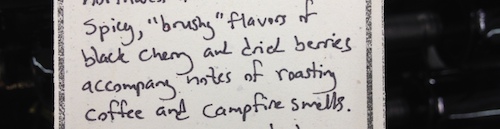
Spicy, “brushy” flavors of black cherry and dried berries accompanying notes of roasting coffee and campfire smells. Description courtesy by the good folks at Lake Wine and Sprits in Minneapolis.
Spicy, “brushy” flavors of black cherry and dried berries accompanying notes of roasting coffee and campfire smells. Description courtesy of the good folks at Lake Wine and Sprits in Minneapolis.

The description is certainly evocative. Already, I can imagine the brush pile I’ve gathered to add to the fire beneath my skillet. In my mind, I see the texture of the sticks, and I can imagine their smell (along with a general sense of being damp and cold, alas). But I still have no idea of how this wine will taste. After all, I haven’t invested any time in developing my palate and taste memory, or a consistent language for talking about these things. I am reduced to relying on descriptions given to me by the wine merchant, and the vague recollection of having enjoyed wines in the past whose descriptions invoked the fabled black cherry (a fruit I’ve never tasted).

Talking about singing shares some of the same challenges as talking about wine. Your experience as a singer, just like your experience tasting things, is completely subjective. No one else gets to hear or feel what you’re hearing and feeling as you sing. We can certainly take guidance from other singers and from our teachers. But ultimately, we must develop our own memory bank of sense experiences, our own language to describe them.

The downside is that there’s a lot to learn. The upside is that the mind loves novelty. When you learn something new in the body, even in an area that seems outside the realm of vocal technique, your sound will benefit. For the singer, the entire body is the palate for the voice.

For inspiration, I offer up the advice of Victor Hazan, from the chapter on tasting in his 1982 book Italian Wine (page 10):

Using one’s nose is the most elusive exercise in tasting. To harness this impetuous organ we need to learn how to add mindfulness to instinct. One difficulty is that the words that describe scents usually reach us with more force than the scents themselves. Such words as rose, violet, pepper, coffee rush to our brain, arousing imperious sensations that do not seem quite to match the ethereal fragrances in wine that go by the same name.

Another problem is our impoverished store of remembered smells. The fragrances of honestly ripened fruit, of wild berries and mushrooms, of field flowers, of wood have been edited out of everyday experience and replaced by those of plastic film, metal foil, polymers, and acetate.

For many of us it will be necessary to replenish the depleted stores of our olfactory memory, conducting our noses through produce markets, gardens, fields, woods, wherever it can assemble the most varied collection of well-identified impressions. Most of what a wine has to tell is spoken by its odors. Smelling is the most intimate contact we have with wine, when we draw close to, as it were, its very breath.

Go forth and smell the world, oh singer, lest ye be reduced to buying the voice based only on the label.

Rock your Liver: A Tale of Two Passaggios

A detail from Olaus Magnus' 1539 <em>Carta Marina</em>.
The singer enters her vocal Bermuda Triangle, and this ship is going down. A detail from Olaus Magnus’ 1539 Carta Marina.

Most singers have what I think of as a Bermuda Triangle area of the voice, the place where you gaze with trepidation upon the score and think: “Oh no! This ship is going down, and no one will ever know what happened to it.”

For me, this place is a single note, D5 (the D in the trebel staff). Even more particularly, an ascending leap to this note, which is smack dab in the middle of my passaggio.

For those of you not familiar with the word, it comes from classical Italian vocal technique, and refers to areas of the voice where the singer must transition between registers. Singing on either side of the passaggio can feel very different, and transitioning smoothly through the area can feel like trying to open a door while holding a chainsaw, three squirming kittens, and a brimming cup of very hot coffee that you must not spill.

Over the years, I’ve had to come to an understanding with my vocal Bermuda Triangle many times. When I get it right, singing my D feels effortless – I could leap to that note all day long. When I land badly? Well, think of your worst day in Junior High, and imagine having to live through that day again, only without pants. A bad sing can be emotionally devastating for any of us. And the bigger the past devastation, the bigger the anticipatory flinch the next time round.

If you’ve ever been downhill skiing, you are perhaps familiar with this situation: You get off the chair lift and survey the slope below you. It’s a lot scarier than what you had hoped for. Not only is it rather steep, but conditions have conspired to put a glaze of ice on the slope, which is now littered with the detritus of other out-hilled skiers, beckoning to you like sirens as you go flailing by. But since the only way out of the situation is down, you gird your loins, say a little prayer to your knees, and chant to yourself the thing your ski instructor said to you in that lesson you had once: “Face the downhill slope.” And it’s amazing how well this rule can work. But the moment you seek to avoid gravity’s influence; the moment you freak out and turn away, as if to claw you way back up the hill, you’re down.

At one time in my life, the feeling of dread I had from leaping into my passaggio was so similar to that of flinching away from a scary hill (and then wiping out), that I started to use the metaphor of facing the downhill slope in my vocal practice.

It makes a kind of sense. When you flinch, you tense up your muscles, and turn away from the perceived threat. In the case of skiing, the threat would be gravity. For singers, the threat is the audience. In both cases, facing the downhill slope is about changing your attitude towards this perceived threat. Instead of seeing gravity or the audience as the enemy, we seek to have a relationship with it, and that relationship can be exhilarating. Downhill skiing can feel like dancing with gravity. When you’re in a good relationship with your audience, it feels like they’re all in the band with you.

So facing the downhill slope became a metaphor for facing my passaggio fears. But the metaphor also had some movement implications that got me into trouble. I developed an assertive singing posture, standing on the balls of my feet, and leaning forward, as if facing a boxing opponent or, say, plunging down the hill on skis. If I was facing my fears, it was in a fighter’s posture, and you certainly don’t want to be fighting with your audience (even on the days when it seems like they want to fight with you).

Fast forward a few years: Enter the Liver.

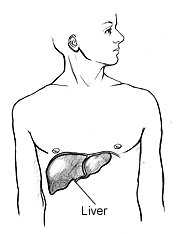
Liver Location

Your liver is principally on the right side of your body, just below the diaphragm, mostly tucked under the lower ribs. It’s a large and dense organ, weighing as much as three and a half pounds. I once had a physical therapist who theorized that people are more likely to tilt their heads to the right than to the left, on account of the relative weightiness of the liver, as opposed to the stomach, pancreas and spleen, over on the left. I have no idea whether this is true or not, but next time you’re in people-watching mode, notice head tilts, and report back. Certainly, you see plenty of singers with an inclination to tilt.

But I digress.

You can help yourself imagine the location of your liver thusly: Put your right hand on the right side of your back, over the lowest ribs. Put your left hand on the front, right side of your body, half on the bottom ribs and half on the belly. Now think of this space between your hands; it is largely occupied by the liver!

Keeping your hands in this position, breathe normally and feel the movement in this area as you inhale and exhale.

Now, as you continue breathing, round your back slightly, and imagine the liver sliding toward the hand on your back. Then arch your back and imagine your liver moving forward into the hand on the front of your body.

Whenever I try a new movement activity, I like to see how it effects the movement challenges particular to singing. So when I first tried liver rocking, I pulled out my personal bête noir of singing-movement challenges, and tried some leaps into the passaggio… and the clouds parted and the stormy seas receded and suddenly the passaggio wasn’t scary at all — it was fun.

I do not mean to suggest that rocking your liver will solve all of your passaggio issues. After all, learning to sing is not about following the recipe; it’s about developing the skills to write your own cookbook.

For me, visualizing the position of the liver and consciously moving it helped release a holding pattern that I hadn’t even realized was there; one that inhibited the movement of my voice. Whereas my “face the downhill slope” metaphor was a complicated version of “don’t flinch”, or “don’t be afraid,” rocking my liver provided a path toward release, towards a feeling of ease.

The big question remains: will rocking my liver help my downhill skiing?

Singing After the Fallow Times

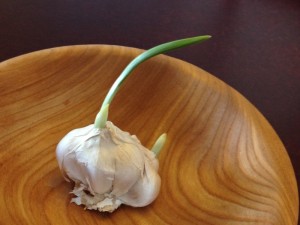
This garlic is pointing toward spring.

This morning, I sacrificed an onion for my breakfast. When I cut it in half, I noticed its center was greening up. February barely has its pants on, I thought, and yet this onion, at least on the inside, is thinking about spring. And it isn’t the only bulb in my kitchen with such thoughts; the garlic is sprouting, too. I found myself looking out the window at the snowy yard and wondering if, down below, the bulbs were flexing their sense of green, listening for cues from sun and dirt for the right moment to send forth a shoot.

Even in the fallow times, when the days are still cold and the night is long, growth happens, though it might be hidden from sight.

When I was a kid, we had a resplendent vegetable garden, mostly tended by my father, who also took on the annual task of food preservation. Our winter pantry was filled with jars of dried legumes, canned tomatoes, courses of braided onion and garlic bulbs, newspaper-wrapped cabbage heads and wooden boxes filled with carrots packed in sand. ‘Round about now, in early February, those carrots would become perfect; incredibly crisp and sweet. Later, when they turned woody and unpalatable, we’d feed them to the goats or go back to putting them in stews, but for a few weeks, we’d revel at their sweet crunchiness, a balm for a dark time of year when our apples (and the hands that pared them) were inclined to wrinkle and dry out.

This week, I find myself reflecting on my sprouting onions and those sweet carrots. I’m thinking of the ways, as a singer, I might green up from within after the voice has been fallow: after a sleep; after the dark times of sorting through tax records; after a pause for illness.

How can I sing from my innermost layer?

Behind the Scenes at the Kidney Cabaret

Glowing Exit Sign
This is not stage lighting.

Imagine this: You arrive at the recital hall. You’re warmed up and ready to sing; your hair and makeup are done, your outfit looks great; the tickets are all sold and the audience is starting to assemble. But the person who is supposed to run the light board hasn’t shown up. You can’t even turn on the house lights. The performance start time has come and gone, the minutes are ticking away, and everyone is still sitting in the dark (yes, this happened).

Take heart. The behind-the-scenes lighting gal might have flaked, but at least your kidneys are still working.

Continue reading Behind the Scenes at the Kidney Cabaret →

Why learning how your organs move can improve your voice and reduce stage fright

A plate from Julien Bouglé's 1899 anatomy atlas.
From Julien Bouglé’s 1899 anatomy atlas: Le corpus humain et grandeur naturelle. You can browse plates from this atlas at the National Library of Medicine’s online exhibit of historical anatomies here.
When I was a young lass, my brother taught me this one neat trick: if someone – say your kid brother – is about to punch you in the stomach, and for some reason you can’t block him, you can tense up all of your abdominal muscles to protect yourself. He and I diligently (and noisily) practiced this skill on one another, generally until some adult would separate us, or threaten a month of nothing but mushroom ice cream for dessert.

How old were we? Seven and nine? Eight and ten? Whatever the age, I’m sure I already knew how to protect my vital organs by tensing my muscles. It’s instinctual. Just as the rib cage protects the heart and lungs, the abdominal wall musculature can protect the organs in our abdominal cavity.

Continue reading Why learning how your organs move can improve your voice and reduce stage fright →